Quick answer
Pet insurance cost by breed varies a lot, because breed is one of the biggest factors in your quote. Breed is one of the biggest factors behind your pet insurance quote, right alongside age and location (see average pet insurance costs). Giant and brachycephalic (flat-faced) breeds with known health risks — Mastiffs, French Bulldogs, Rottweilers — can run $60–$130/month. Meanwhile, hardy, genetically diverse breeds like mixed breeds or Border Collies often land at $25–$50/month for similar coverage.
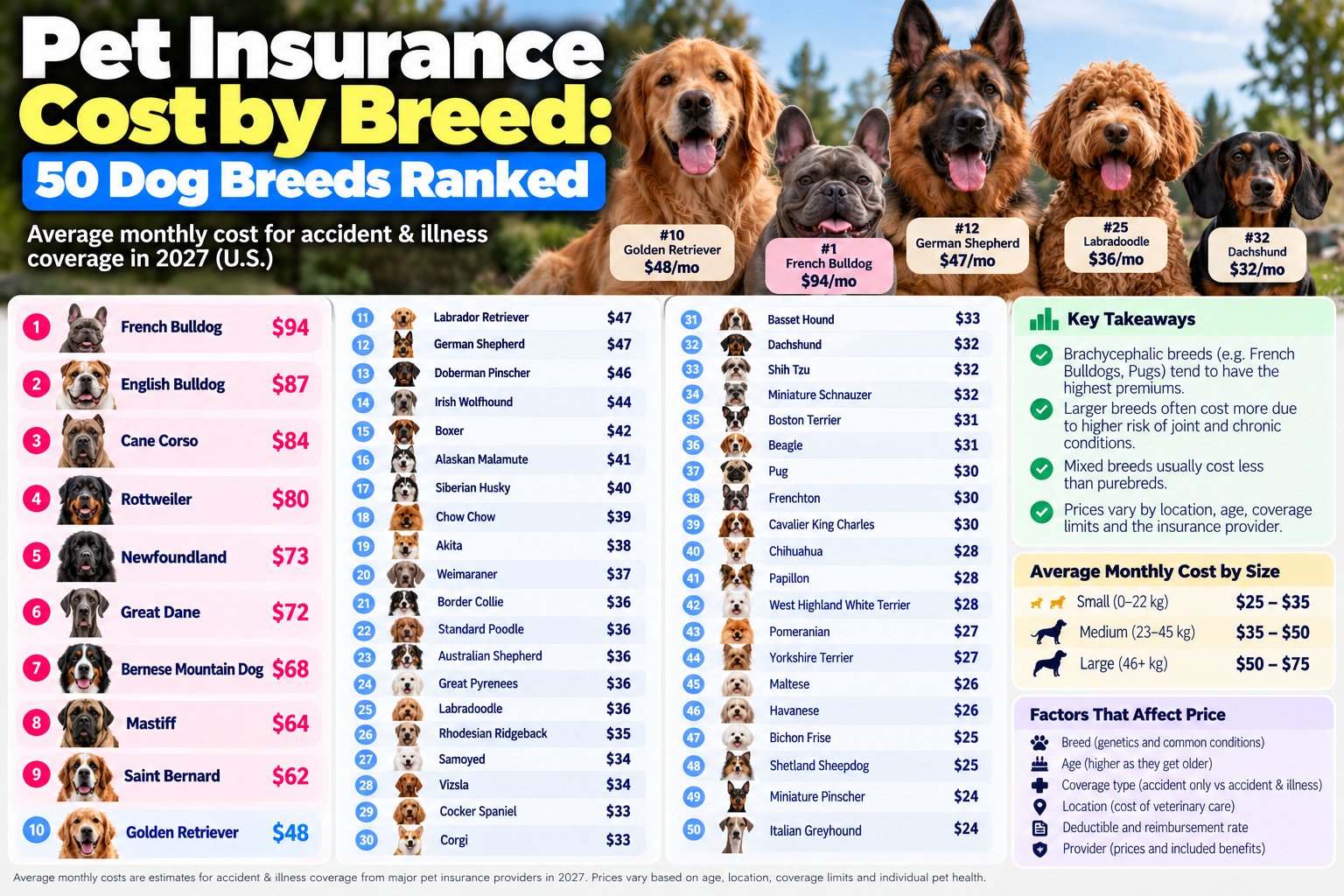
The nationwide average sits around $43/month for dogs and $23/month for cats on an accident-and-illness plan. But that average hides a huge range once you factor in breed-specific risk.
Why breed changes the price
Insurers price breeds by their statistical risk, built from claims data across the whole industry. The main drivers:
- Brachycephalic (flat-faced) breeds — French Bulldogs, English Bulldogs, Pugs — face more respiratory, spinal, and eye problems, which pushes costs up.
- Large and giant breeds cost more to treat (bigger doses, bigger surgeries) and often have shorter lifespans with more joint and heart issues.
- Known genetic disorders specific to a breed — hip dysplasia, IVDD in Dachshunds, heart conditions in Cavaliers — raise the odds of an expensive claim.
- Lifespan matters: a breed that lives fewer years but develops chronic conditions late in life can be costlier to insure than a breed that simply lives longer.
- Mixed breeds tend to cost less because they’re less likely to carry a single breed’s concentrated genetic risks.
Age, your location, and your chosen deductible/reimbursement combo still move the number a lot (see how pet insurance deductibles work). Breed sets the baseline, it doesn’t fix the final price.
The most expensive breeds to insure
| Breed | Typical monthly range | Main risk factors |
|---|---|---|
| Mastiff | $69–$130 | Short lifespan, hip dysplasia, cataracts, certain cancers |
| French Bulldog | $64–$114 | Brachycephalic: respiratory, spinal, eye, and eyelid issues (see French bulldog pet insurance) |
| Rottweiler | $65–$110 | Hip/elbow dysplasia, bone cancer, heart problems |
| Bernese Mountain Dog | $60–$103 | High cancer risk, joint issues, short lifespan |
| Great Dane | $60–$85 | Bloat, heart disease, hip dysplasia; size raises treatment cost |
| English Bulldog | $55–$95 (est.) | Brachycephalic breathing issues, skin fold infections, hip dysplasia |
| Golden Retriever | $59–$115 | Elevated cancer risk, hip dysplasia (see golden retriever insurance) |
Golden Retriever figures reflect $5,000 annual coverage at the low end and an unlimited-payout plan at the high end. The spread shows how much the payout limit alone can move the price for the same breed (see pet insurance with no annual limit).
The least expensive breeds to insure
| Breed | Typical monthly range | Why it’s cheaper |
|---|---|---|
| Mixed-breed dogs | $25–$40 | Genetic diversity lowers the odds of inherited conditions (see mixed-breed dog insurance) |
| Maltese | $25–$40 | Hardy, long-lived, few inherited conditions |
| Border Collie | $27–$41 | Active breed, generally free of major hereditary issues |
| Papillon | $30–$50 | Occasional eye/dental issues with age, but long-lived overall |
| Yorkshire Terrier | $36–$54 | Some eye and kneecap issues, but hardy with a long lifespan |
Notice the pattern: every breed on this list is small-to-medium, long-lived, and free of the breed-specific genetic conditions that drive up claims for the breeds in the table above.
Where other popular breeds land
Most breeds fall somewhere between those two extremes. Based on their known risk factors, here’s roughly where some other common breeds sit:
| Breed | Cost tier | Why |
|---|---|---|
| Labrador Retriever | Medium | Generally healthy, but prone to hip/elbow dysplasia and obesity-related issues |
| German Shepherd | Medium-high | Hip dysplasia, degenerative myelopathy, bloat risk (see German shepherd insurance) |
| Dachshund | Medium | Low treatment cost per visit, but high risk of IVDD (disc disease), which can mean expensive surgery (see dachshund pet insurance) |
| Cavalier King Charles Spaniel | Medium-high | High rate of mitral valve heart disease, often starting relatively young (see Cavalier King Charles insurance) |
| Goldendoodle | Medium | Inherits some Golden Retriever and Poodle risk factors, but hybrid vigor softens it somewhat (see Goldendoodle pet insurance) |
| Maine Coon (cat) | Medium | Higher risk of hypertrophic cardiomyopathy (HCM) and hip dysplasia for a cat breed (see Maine Coon cat insurance) |
| Persian (cat) | Medium-high | Brachycephalic face shape brings breathing and eye issues similar to flat-faced dog breeds (see Persian cat insurance) |
These are directional cost tiers based on each breed’s documented health risks, not insurer-published rates. Get an actual quote for your pet’s age and location to see the real number.
How to lower the cost for a high-risk breed
- Enroll as a puppy or kitten. Premiums are cheapest before any condition has a chance to show up, and nothing diagnosed before enrollment can ever be excluded as pre-existing later (see what pet insurance doesn’t cover).
- Choose a higher deductible. Trading a higher deductible for a lower premium can offset a chunk of the breed surcharge.
- Pick a moderate reimbursement rate. 70% instead of 90% lowers the monthly cost meaningfully, especially on a breed already priced at a premium (see pet insurance reimbursement rates).
- Skip wellness add-ons if the core policy is already expensive. Save the budget for the accident/illness coverage that actually protects against the big, breed-specific risk.
- Compare insurers specifically for your breed. Pricing models differ enough between companies that the «cheapest» insurer for a Labrador isn’t necessarily the cheapest for a French Bulldog (see how to compare pet insurance quotes).
FAQ
Is mixed-breed insurance always cheaper? Usually, yes. Genetic diversity tends to lower the odds of a single inherited condition driving up claims, though age, size, and location still matter.
Why do flat-faced breeds cost so much more? Brachycephalic breeds (French Bulldogs, English Bulldogs, Pugs, Persians) are prone to chronic respiratory, spinal, and eye problems that generate frequent, often lifelong claims.
Does breed affect whether I can get coverage at all? Rarely. Most insurers cover every breed, though a few may exclude specific hereditary conditions by breed rather than refusing the breed outright.
Can two dogs of the same breed get very different quotes? Yes. Age, location, and your chosen deductible/reimbursement/limit combination can move the price as much as breed does.
Bottom line
Breed sets the starting point for your premium, driven by each breed’s documented health risks — size, lifespan, and known genetic conditions all factor in. Giant and flat-faced breeds pay the most; mixed breeds and a handful of hardy small breeds pay the least. Wherever your pet falls, enrolling early and picking the right deductible/reimbursement combo can meaningfully soften a high-risk breed’s price tag.
For the specific breeds in this list, see the full breed-by-breed guides:.
Sources
Sources
- Most and Least Expensive Dog Breeds to Insure — The Zebra — thezebra.com
- How Much Is Pet Insurance? — Insurify — insurify.com
Key Takeaways on Pet Insurance Cost By Breed
- Breed is one of the biggest factors in your quote, alongside age and location.
- Giant and flat-faced breeds with known health problems cost more to insure.
- Use the breed table as a guide, then get a quote for your own dog.
By Joaquín Benicio Conforti · Last updated: October 2026