Quick answer
Maine Coon cat insurance deserves a careful look because the breed has two specific health risks that affect which plan fits. Maine Coon insurance costs more than the average cat policy, which Insurify put at about $23 a month in May 2026, with the two breed-specific risks to watch being hypertrophic cardiomyopathy (HCM), a heart condition, and hip dysplasia. Unusual for a cat breed but well-documented in this one given its larger size (see pet insurance cost by breed). Both are covered as standard illnesses on any accident-and-illness plan, as long as you enroll before either shows up.
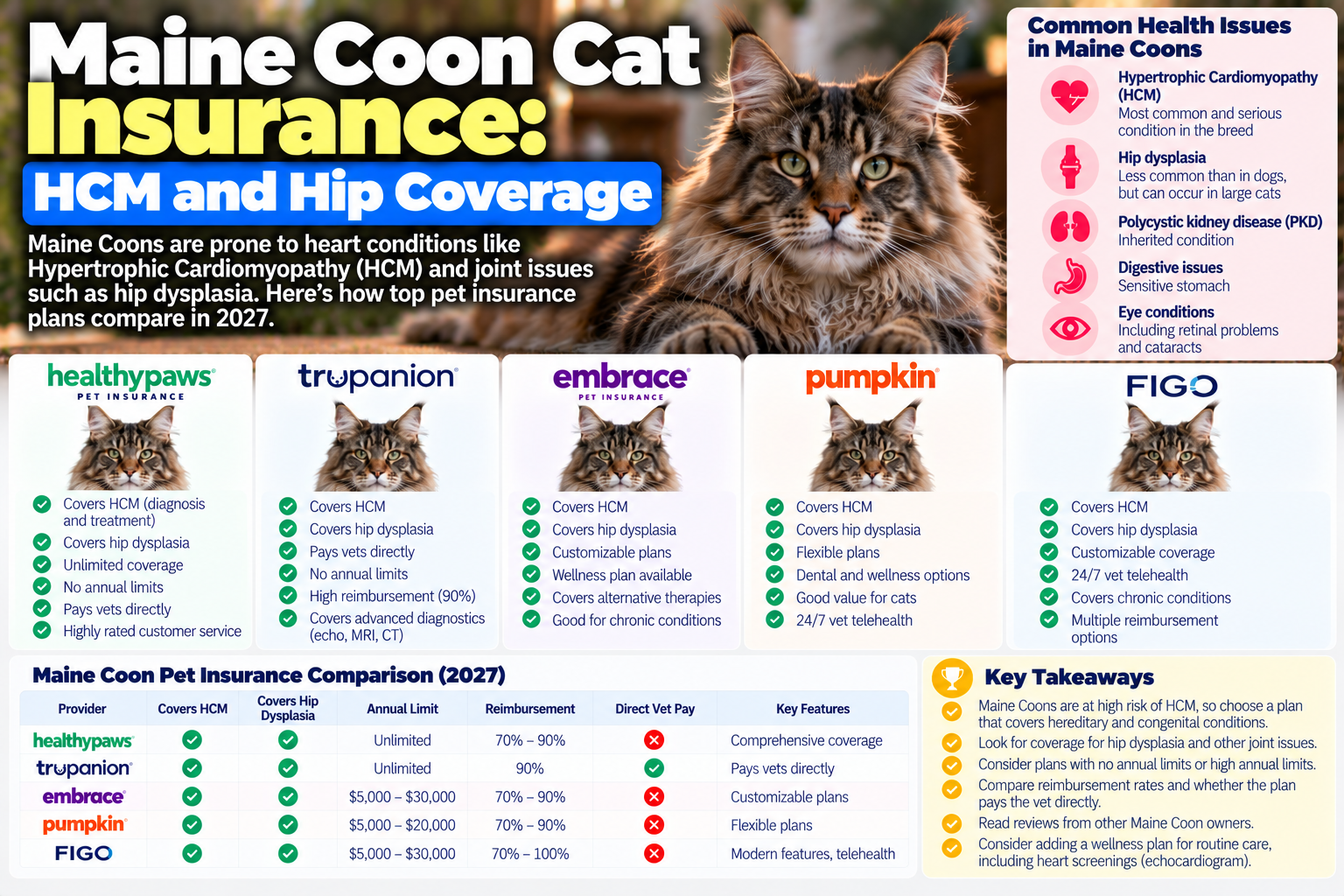
A plan with a high annual limit and clear hereditary-condition coverage matters more here than for most cat breeds, since HCM in particular can mean ongoing cardiac monitoring for years (see pet insurance with no annual limit).
HCM and hip dysplasia: what they are, and what they cost
Hypertrophic cardiomyopathy (HCM) is a thickening of the heart muscle that can lead to heart failure or sudden complications if untreated. It’s the Maine Coon’s most significant breed-specific risk, and the average cited HCM claim payout is around $1,200. Though ongoing monitoring (echocardiograms, medication) adds to that over time rather than being a single bill.
Hip dysplasia is less commonly discussed in cats, but documented in Maine Coons given the breed’s unusually large size for a domestic cat. The same joint malformation seen in large dog breeds (see golden retriever insurance), with similar surgical costs when severe.
Together, these two conditions are why Maine Coon owners should treat this breed less like a «typical cheap-to-insure cat» and more like a breed with real, documented hereditary risk.
Pricing
Location alone moved the same insurer’s quote by over 50% in this example. Always get a quote for your specific zip code rather than relying on a national average (see average pet insurance costs).
What to prioritize, and waiting periods
- A high annual limit. Healthy Paws and Trupanion both offer unlimited payouts (see our Healthy Paws review) (see our Trupanion review). Lemonade ranges $5k–$100k and ASPCA $5k–$10k — worth comparing given HCM’s potential for ongoing cardiac costs.
- Confirmed hereditary condition coverage. Both HCM and hip dysplasia need to be explicitly treated as covered illnesses, not footnoted exceptions.
- Waiting periods (see pet insurance waiting periods): most insurers use about 14 days for illnesses and 2–5 days for accidents. Trupanion specifically requires 30 days for orthopedic conditions, relevant given the hip dysplasia risk here.
- Reimbursement rate. A higher rate (80–90%) matters more on a chronic condition like HCM than on a single accident, since the costs recur (see pet insurance reimbursement rates).
Enrollment timing and pre-existing condition traps
Enroll your Maine Coon kitten as early as possible. Both HCM and hip dysplasia can develop with no obvious symptoms until a vet specifically screens for them, and once either is noted in a record, it’s excluded going forward (see what pet insurance doesn’t cover). Many breeders screen for HCM before selling kittens. If yours has a clean echocardiogram on file, getting insured right after that screening (rather than waiting) locks in coverage before anything could change.
Curable conditions can sometimes be covered again after a symptom-free waiting period with some insurers. But HCM and hip dysplasia are typically treated as chronic/hereditary rather than curable — so this exception rarely applies to the breed’s two main risks.
FAQ
Is HCM common enough to worry about in every Maine Coon? It’s documented as a breed-specific risk, though not every cat develops it. It’s a strong enough pattern that insuring early is worth doing regardless.
Does hip dysplasia really affect cats? Yes, though it’s far more commonly discussed in dogs. Maine Coons, being one of the largest domestic cat breeds, show it often enough to be a documented concern.
Is Maine Coon insurance cheaper than dog insurance generally? Yes. Cats typically cost less to insure across the board, and Maine Coons still land well under most dog breeds despite their specific risks.
Should I get a cardiac screening before buying insurance? It depends on the insurer’s requirements. Ask directly, since a screening result (clear or not) can affect how HCM coverage is treated later.
Bottom line
Maine Coon insurance stays affordable relative to most dog breeds, but HCM and hip dysplasia are real, documented risks worth insuring against specifically. Both are standard illness claims as long as you enroll before either shows up. A plan with a high annual limit and clear hereditary coverage handles the breed’s actual risk well without needing the most expensive tier available.
Sources
Key Takeaways on Maine Coon Cat Insurance
- Maine Coon insurance typically runs $18–$50 a month.
- Watch for hypertrophic cardiomyopathy (HCM) and hip dysplasia.
- Enroll before a heart diagnosis can be excluded as pre-existing.
By Joaquín Benicio Conforti · Last updated: October 2026