Quick answer
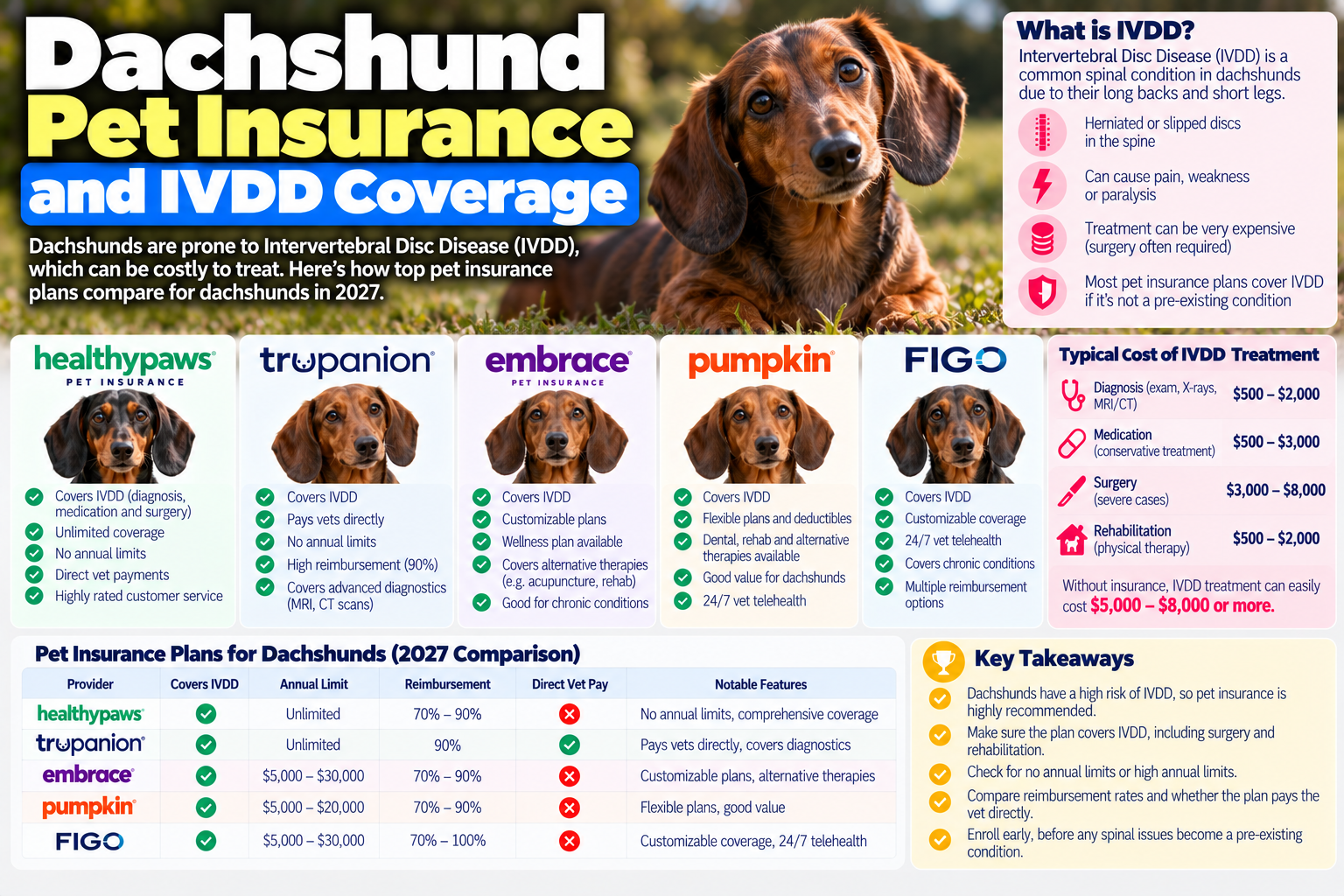
Dachshund pet insurance matters mainly because of back problems, and the surgery that follows is expensive. Dachshunds have the highest reported rate of IVDD (intervertebral disc disease) of any surveyed breed — 15.3% in a 2025 study. And IVDD surgery typically costs $2,000–$8,000 (see pet insurance cost by breed). That single risk is the main reason to insure a Dachshund specifically. It’s covered by standard accident-and-illness plans as long as it develops after your policy starts and after any waiting period.
Premiums often land at or slightly above the small-breed average, with the real variable being your deductible, reimbursement rate, and how early you enroll relative to when symptoms first appear (see what pet insurance doesn’t cover).
IVDD explained: what it is, and what it costs
Intervertebral disc disease (IVDD) happens when a spinal disc degenerates, bulges, or ruptures and presses on the spinal cord. The Dachshund’s long back and short legs make the breed especially prone to it. A 2025 study found Dachshunds had the highest reported IVDD rate of any breed surveyed, at 15.3% (83 of 541 dogs).
Symptoms range from mild back pain and reluctance to jump, up to sudden hind-limb weakness or paralysis in severe cases — which can require emergency surgery.
Typical cost: IVDD surgery runs $2,000–$8,000 according to veterinary sources, not counting pre-surgical imaging, consultations, medication, or the extended crate rest that follows. On a $6,000 bill, a $500 deductible and 80% reimbursement would return about $4,400. A meaningful dent in what would otherwise be a five-figure-adjacent out-of-pocket hit for many households (see pet insurance reimbursement rates).
Other common Dachshund health issues
- Obesity-related back strain. Extra weight loads the spine and can speed up disc degeneration. One of the few IVDD risk factors you can actually influence through diet and exercise.
- Patellar luxation (kneecap dislocation). Common in small breeds generally; mild cases cause occasional skipping, while severe cases may need surgery.
- Dental disease. Tooth crowding traps plaque, which can lead to extractions and infections over time — a recurring, lower-cost but ongoing claim category.
Pricing, and what to prioritize
The national average for dog accident-and-illness coverage sits around $43/month (see average pet insurance costs). Dachshund premiums tend to land at or modestly above the small-breed average rather than spiking the way a giant or brachycephalic breed’s does.
For this breed specifically, prioritize:
- A higher annual limit, or unlimited coverage, since IVDD can recur. A second disc event later in life means a second expensive claim against the same yearly cap (see pet insurance with no annual limit)
- A reimbursement rate of 80–90% if it fits your budget — the gap between 70% and 90% reimbursement on a $6,000 surgery is over $1,000
- A deductible you’re comfortable paying suddenly, since IVDD can present as an emergency rather than something you see coming (see how pet insurance deductibles work)
Enrollment timing and pre-existing condition traps
This is the single most important decision for a Dachshund owner: enroll while your dog is young and completely symptom-free. IVDD diagnosed before your policy starts, or during the waiting period, is excluded as pre-existing. And because symptoms can start subtly (reluctance to jump, mild back sensitivity), it’s worth insuring before you notice anything at all, not after.
A few specifics to confirm before buying:
- The illness waiting period length, since the article sources don’t standardize this — ask directly rather than assuming (see pet insurance waiting periods)
- Whether spinal/back conditions carry any extended wait, similar to how some insurers add extra time for orthopedic conditions in other breeds
- What counts as «symptomatic» — a vague back-pain note in your dog’s chart from a routine visit could be enough for an insurer to treat a later IVDD diagnosis as related and excluded
FAQ
Is IVDD always treated with surgery? No — mild cases are sometimes managed conservatively with rest and medication. But moderate-to-severe cases, especially with hind-limb weakness, often need surgery for the best outcome.
Will insurance cover a second IVDD episode later in life? Yes, as long as it’s a new episode after your policy started and within your annual limit. Which is exactly why a higher or unlimited limit matters more for this breed.
Can I lower the risk of IVDD myself? Keeping your Dachshund at a healthy weight and limiting activities that strain the back (jumping off furniture, stairs without support) are the main modifiable risk factors, though genetics play the larger role.
At what age should I insure a Dachshund? As early as possible, ideally as a puppy. IVDD can show up anytime from young adulthood onward, and once it’s symptomatic, it’s excluded for good.
Bottom line
IVDD is the defining risk for Dachshund owners buying pet insurance. It’s the breed’s single most common and most expensive likely claim, running $2,000–$8,000 per surgery. Standard accident-and-illness coverage handles it well as long as you enroll before any symptoms appear and pick a plan with a high annual limit in case it recurs.
Sources
- Dachshund Pet Insurance Cost — Spot Pet Insurance
- PetMD — IVDD surgery cost estimates
Sources
- Dachshund Pet Insurance Cost — Spot Pet Insurance — spotpet.com
Key Takeaways on Dachshund Pet Insurance
- Dachshunds have the highest reported rate of IVDD of any surveyed breed, 15.3% in a 2025 study.
- IVDD surgery typically costs $2,000–$8,000.
- Enroll early and check how back conditions are covered.
By Joaquín Benicio Conforti · Last updated: October 2026