Quick answer
Goldendoodle pet insurance prices vary widely, so the numbers below are best read as ranges rather than fixed quotes. Goldendoodle insurance typically runs $25–$37/month for a young adult dog, with industry-wide ranges as broad as $15–$66 depending on age and location (see pet insurance cost by breed). As a Golden Retriever/Poodle cross, the breed inherits risk from both sides — hip dysplasia, cruciate ligament tears. A heart condition called subvalvular aortic stenosis (SAS) show up often enough to plan around.
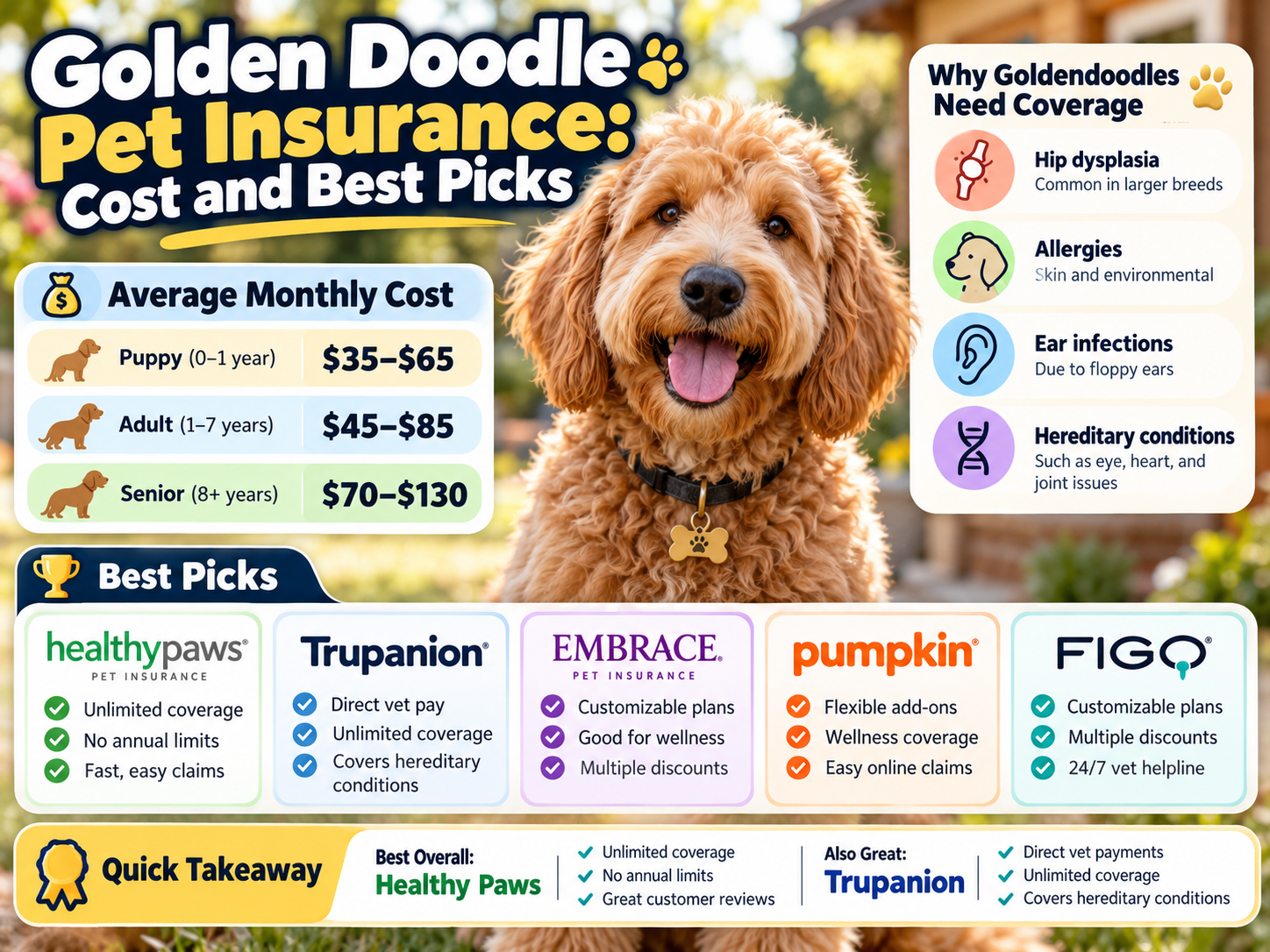
An accident-and-illness plan with solid joint and cardiac coverage, paired with early enrollment, covers the breed’s real risks without needing the most expensive tier available (see what pet insurance doesn’t cover).
Goldendoodle health risks and what they cost
| Condition | What it is | Typical cost |
|---|---|---|
| Hip dysplasia | Inherited joint malformation, common on the Golden Retriever side (see golden retriever insurance) | $2,000–$7,000 for surgery; $500+/year for non-surgical management |
| Subvalvular aortic stenosis (SAS) | A narrowing below the aortic valve, restricting blood flow | ~$1,000 for diagnostic testing; balloon catheterization surgery starts at $5,000; ongoing beta-blocker medication |
| Cruciate ligament (CCL) rupture | A torn knee ligament, common in active, larger dogs | ~$5,000 for surgery and post-op care; $20–$50/month pain medication; ~$50/session physical therapy |
| Addison’s disease | Adrenal gland disorder requiring lifelong hormone management | $50–$500/month ongoing; ~$150 for diagnostic testing; $500–$3,000 for an urgent episode |
| Epilepsy | Seizure disorder | $2,500–$5,000 for diagnostics (bloodwork, CT/MRI); $200–$5,000/year for medication |
The spread here is wide — a Goldendoodle with no issues costs little to insure. But any one of these conditions can turn into a recurring, multi-year expense.
Sample monthly premiums by insurer
For a 1-year-old male Goldendoodle (sample quote, Texas zip code):
| Insurer | Sample monthly premium |
|---|---|
| Healthy Paws | ~$25.32 |
| Embrace | ~$31.96 |
| ManyPets | ~$34.20 |
| Pets Best | ~$37.40 |
These are illustrative quotes for one age, location, and set of plan terms — your actual price will vary by your dog’s age, zip code. The deductible/reimbursement you choose (see how to compare pet insurance quotes).
Best picks, and why
- Healthy Paws — the cheapest sample quote here, plus unlimited annual and lifetime payouts, which matters given how many of this breed’s conditions (SAS, Addison’s, epilepsy) involve years of ongoing cost rather than a single bill (see our Healthy Paws review).
- Embrace — a solid mid-price option with a diminishing deductible that rewards a Goldendoodle that stays healthy between claims.
- Pets Best or ManyPets — reasonable middle-ground pricing if Healthy Paws’ structure (no wellness, no exam fee coverage) doesn’t fit what you want.
Whichever you choose, confirm hereditary and congenital conditions are explicitly covered. Hip dysplasia and SAS both fall under that umbrella, and it’s worth seeing it spelled out rather than assumed.
What to prioritize, and when to enroll
- Enroll as a puppy. SAS, epilepsy, and joint issues can all show up well before a dog is fully grown. Getting insured early keeps all of them covered rather than excluded.
- Don’t skip the cardiac exam if your insurer offers one. SAS specifically can sometimes be screened for, which may affect waiting periods or terms depending on the insurer.
- Pick a higher annual limit over the cheapest premium. Several of this breed’s conditions (Addison’s, epilepsy) are lifelong and recurring, not one-time (see pet insurance with no annual limit).
- A moderate deductible ($250–$500) is usually the sweet spot. High enough to keep the premium reasonable, low enough that a $5,000 CCL surgery doesn’t feel like starting from zero.
FAQ
Are Goldendoodles healthier than purebred Golden Retrievers? Not definitively — hybrid vigor can soften some risks. But Goldendoodles still inherit real conditions from both parent breeds, including hip dysplasia and cardiac issues.
Does insurance cover epilepsy? Yes, as long as the first seizure happens after your policy starts and after the waiting period. Ongoing medication and diagnostics are covered as part of managing the condition.
Is SAS always serious? Severity varies widely, from mild cases needing only monitoring to severe cases requiring surgery. Either way, it’s worth having coverage in place before any symptoms appear.
How much does Goldendoodle insurance typically cost per year? At the sample rates above, expect roughly $300–$450/year for a young adult dog, before accounting for your specific deductible and reimbursement choices (see average pet insurance costs).
Bottom line
Goldendoodles land in a comfortable mid-range for insurance cost, but the breed’s mixed heritage means real risk from both sides. Joints and cancer predisposition from the Golden, plus conditions like SAS and epilepsy that show up independently. Healthy Paws’ unlimited structure fits well given how many of these conditions are long-term rather than one-off. But any accident-and-illness plan with solid hereditary coverage works if you enroll early.
Sources
Sources
- Top Pet Insurance Plans for Goldendoodles — iHeartDogs — iheartdogs.com
Key Takeaways on Goldendoodle Pet Insurance
- Goldendoodle insurance runs $25–$37 a month for a young adult dog, with industry ranges of $15–$66.
- Age and location move the quote the most.
- Get quotes for your dog’s exact age and ZIP code.
By Joaquín Benicio Conforti · Last updated: October 2026