Quick answer
Persian cat insurance typically runs $15–$70/month, depending on insurer and location (see pet insurance cost by breed). The breed’s two biggest risks are polycystic kidney disease (PKD), an inherited condition affecting the kidneys, and breathing problems tied to its flat facial structure. Similar in spirit to brachycephalic issues in dog breeds like the French Bulldog (see French bulldog pet insurance).
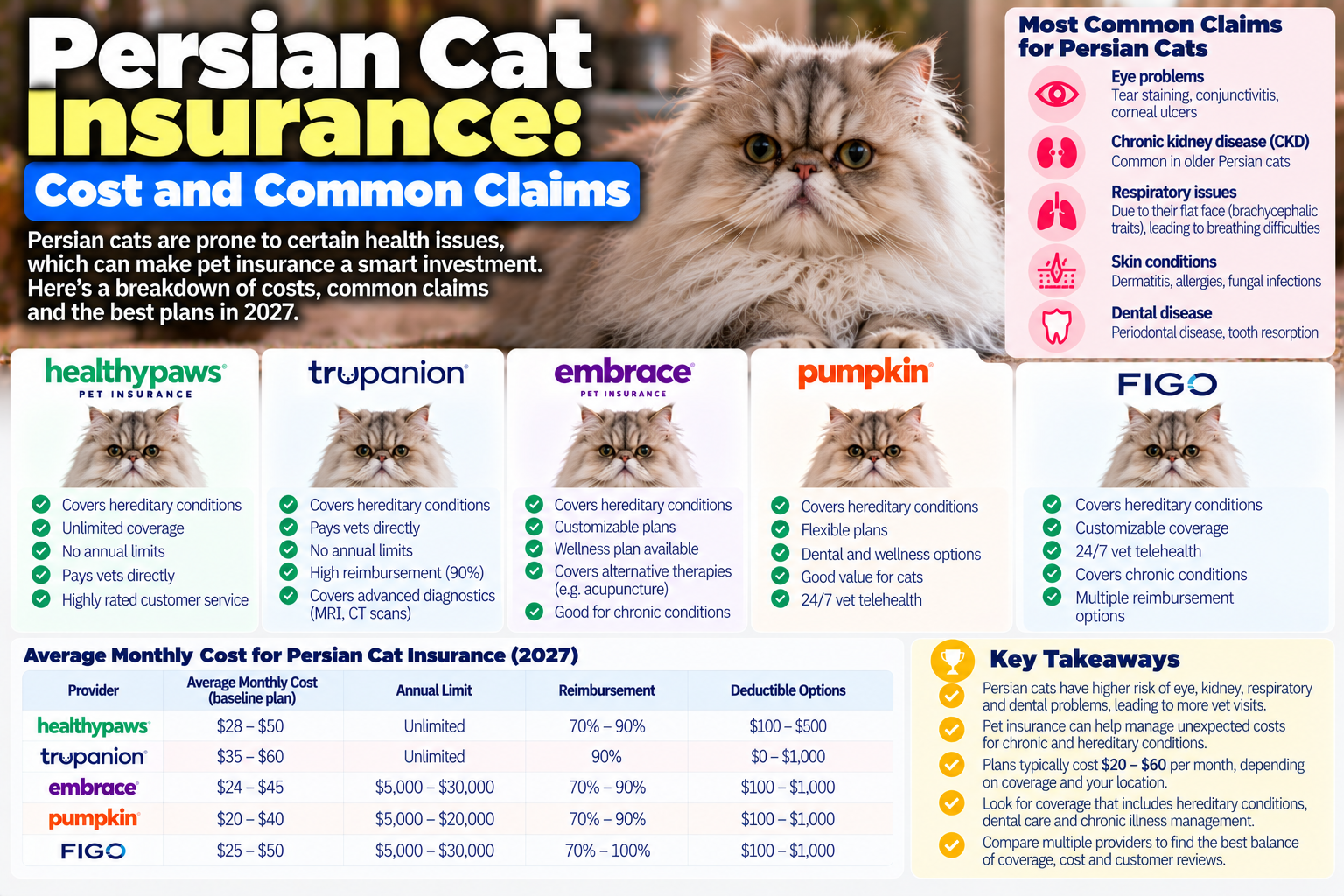
Both are covered as standard hereditary/congenital conditions on any accident-and-illness plan, provided you enroll before either shows symptoms.
PKD, breathing issues, and other common Persian health risks
Polycystic kidney disease (PKD) is an inherited condition where fluid-filled cysts form in the kidneys and gradually impair function. It’s one of the most significant hereditary risks associated with the breed, and like any chronic kidney condition, it typically means years of monitoring and management rather than a single treatment.
Respiratory/breathing problems stem from the Persian’s flat facial structure. The same underlying issue as brachycephalic airway syndrome in flat-faced dog breeds, just less frequently labeled that way for cats.
Other common issues named in breed research include eye problems linked to the flattened face and a generally higher need for routine veterinary care and grooming-adjacent attention than many other cat breeds.
Average claim payouts cited for cats generally run around $1,200 for illness claims and $800 for accident claims. Useful context for what a «typical» Persian claim might actually look like, even before a major PKD diagnosis.
Pricing by insurer
Location shifts the number too, and so do your cat’s age and deductible. Quote the same plan with your own ZIP code at several insurers before you decide.
What to prioritize, and annual limits by insurer
| Insurer | Annual limit |
|---|---|
| Healthy Paws | Unlimited (see our Healthy Paws review) |
| Trupanion | Unlimited (see our Trupanion review) |
| Lemonade | $5,000–$100,000 |
| ASPCA | $5,000–$10,000 |
Given PKD’s long-term nature, a higher or unlimited annual limit is worth prioritizing over the cheapest premium (see pet insurance with no annual limit). Also confirm:
- Hereditary condition coverage is explicit, not assumed — Trupanion is specifically noted for covering these
- Waiting periods, since some insurers (Trupanion among them, per breed research) run longer waits than the typical 14-day illness standard (see pet insurance waiting periods)
- Whether a sample contract lists PKD or kidney disease under any special exclusion, which would be unusual but worth ruling out
Enrollment timing and pre-existing condition traps
Enroll while your Persian is a kitten and healthy, before any PKD screening or kidney finding shows up in a vet record. Once a condition is diagnosed, every insurer treats it as pre-existing and excludes it going forward. This is the single biggest reason Persian owners get denied claims later (see what pet insurance doesn’t cover).
A few timing details to watch:
- Waiting periods typically run 14 days for illness and 1–2 days for accidents. But some insurers — Trupanion among them — run longer waits, so coverage isn’t automatic the day you sign up
- Most plans exclude pre-existing conditions outright, but a few providers, including Trupanion and ASPCA, may still cover certain hereditary or chronic conditions if they’re diagnosed after enrollment and the waiting period has passed. Worth confirming directly with the insurer rather than assuming either way
- PKD screening results count as a record. If your cat has already been tested, disclose it. Insurers can rescind coverage for non-disclosure, which is worse than a straightforward exclusion
FAQ
Is pet insurance worth it for a Persian cat? Yes, especially given the breed’s known risk of polycystic kidney disease and chronic breathing issues tied to their flat-faced structure. Average claim payouts of $1,200 for illness and $800 for accidents show how quickly costs can add up. A diagnosed hereditary condition becomes permanently uninsurable once it’s on record.
Does pet insurance cover PKD in Persian cats? Only if your cat is enrolled and the condition is diagnosed after the waiting period. PKD diagnosed before enrollment, or during a cat’s first vet visit as a kitten, will be treated as pre-existing and excluded by most insurers.
What’s the best pet insurance for a Persian cat? There’s no single best option. It depends on whether you prioritize a low premium (Lemonade, ASPCA) or unlimited lifetime coverage for a chronic condition like PKD (Healthy Paws, Trupanion). Get quotes from at least two or three insurers for your specific cat and zip code.
How much does Persian cat insurance cost per month? Prices vary by insurer, your cat’s age and location; Insurify put the average cat policy at about $23 a month in May 2026. Your location, with West Coast pricing often running noticeably higher than other regions.
Bottom line
Persian cats carry real, documented risks — polycystic kidney disease chief among them, plus breathing difficulties from their brachycephalic skull shape. That make insurance more valuable than it is for an average cat. Enroll as early as possible, before any screening or diagnosis gets written into a vet record, and weigh a higher or unlimited annual limit against the cheapest monthly premium. If PKD risk is a real concern for your cat’s line, Healthy Paws and Trupanion’s unlimited limits and hereditary-condition coverage are worth the extra cost over budget options like Lemonade or ASPCA.
Sources
- Persian Cat Insurance Costs — CatsLuvUs
Key Takeaways on Persian Cat Insurance
- Persian cat insurance varies by insurer and location. The average cat policy was about $23 a month in Insurify’s May 2026 estimates.
- Polycystic kidney disease (PKD) is one of the breed’s two biggest risks.
- Check how each insurer treats inherited conditions.
By Joaquín Benicio Conforti · Last updated: October 2026