Quick answer
German Shepherd insurance averages around $52/month (see pet insurance cost by breed). The breed’s risk profile makes a high annual limit and solid orthopedic coverage more important than the lowest premium. About 20% of OFA-evaluated German Shepherds show hip dysplasia, the breed tops GDV (bloat) case counts in veterinary research. Roughly a third carry the gene linked to degenerative myelopathy.
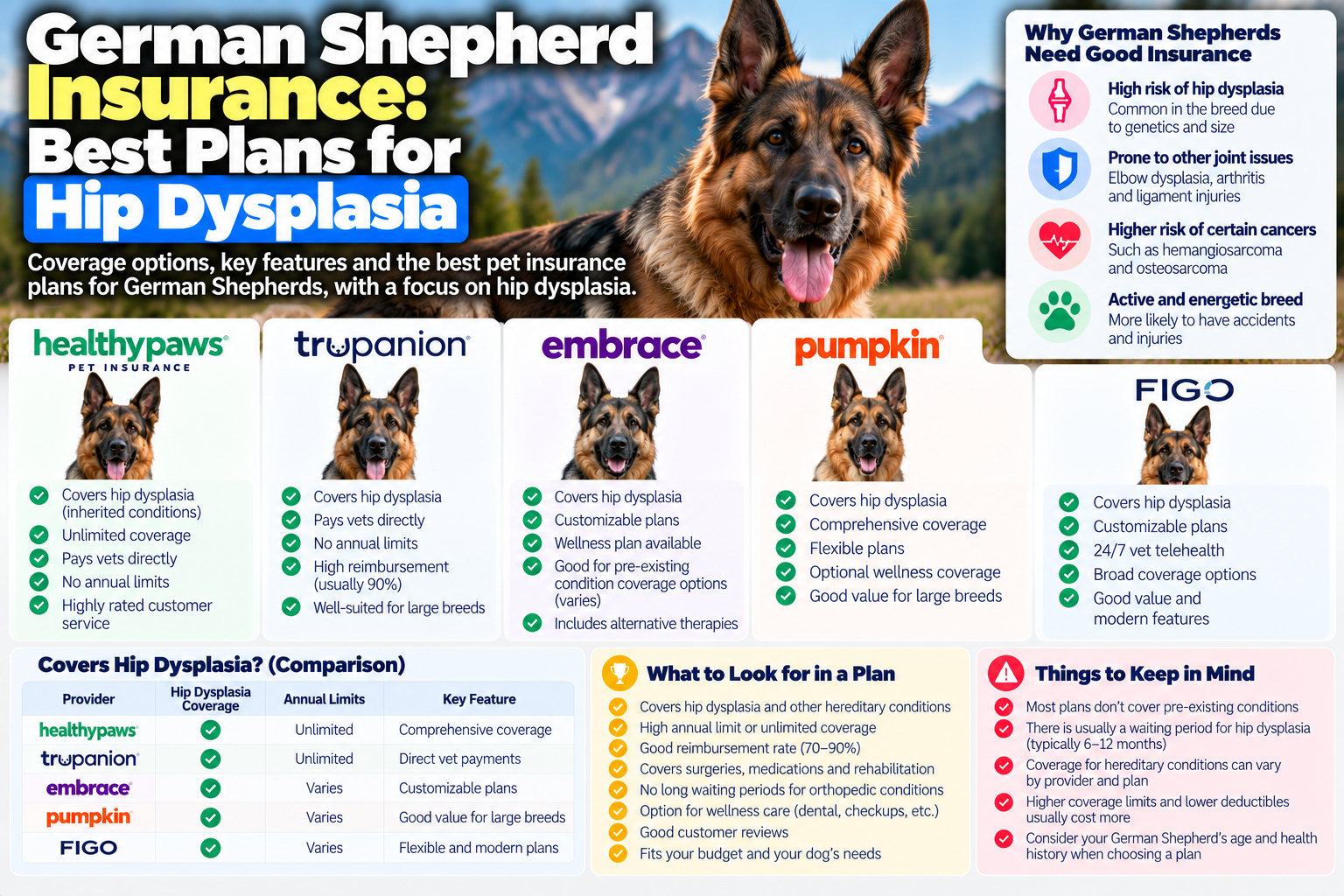
An accident-and-illness plan with a 90% reimbursement rate and a high or unlimited annual limit is the baseline worth prioritizing for this breed (see pet insurance with no annual limit).
German Shepherd health risks and what they cost
| Condition | Prevalence/risk data | Typical treatment cost |
|---|---|---|
| Hip dysplasia | ~20% of OFA-evaluated German Shepherds show signs | $800–$1,000 for juvenile surgery; $3,500–$7,000 per hip for a full replacement |
| Bloat (GDV) | Highest share of any breed in a WSU case review (20.9% of 498 cases) | $1,500–$7,500+ for emergency surgery |
| Degenerative myelopathy | ~35% of German Shepherds carry the associated SOD1 gene mutation (Cornell) | Not typically treatable surgically; cost is mostly ongoing supportive care |
| Elbow dysplasia | Common enough to be a standard health-test item for the breed | Similar range to hip dysplasia surgery |
| Allergies/atopic dermatitis | Identified as a high-risk condition for the breed | Ongoing, usually lower per-visit but recurring |
Bloat is the one to take most seriously here. It’s a true emergency, the breed has the highest case count of any breed in cited research. The surgery bill can hit five figures depending on complications.
Pricing, and what drives it for this breed
The average premium sits around $52/month based on recent policyholder data, but your actual quote moves with:
- Age at enrollment — premiums are lowest when you enroll young. Most insurers accept puppies from 8 weeks old with no upper age limit (see how pet insurance deductibles work).
- Deductible and reimbursement rate — a lower deductible raises the premium. A 90% reimbursement rate gives the most coverage back per claim. This matters more on a $5,000+ hip or bloat bill than it does on routine visits (see pet insurance reimbursement rates).
- Annual limit — given how expensive hip replacement and emergency bloat surgery can get, a higher or unlimited limit is worth the extra premium for this breed.
- Multi-pet discounts — roughly 10% off each additional pet with some insurers, if you’re insuring more than one dog.
Best plans for hip dysplasia and bloat coverage
Most accident-and-illness plans cover hip dysplasia (diagnostics, surgery, medication) and bloat surgery as standard, since both are illnesses/accidents rather than something insurers carve out by name. What actually differentiates plans for this breed:
- Healthy Paws and Trupanion — unlimited annual and lifetime payouts remove the risk of a bloat emergency or hip replacement running past your cap in a single policy year (see our Healthy Paws review) (see our Trupanion review).
- Spot — flexible deductible options (down to $100) if you’d rather pay more monthly and less when a claim happens.
- Trupanion specifically — direct vet pay matters here more than for most breeds, since bloat is a true emergency where fronting a $5,000+ bill immediately can be genuinely hard (see pet insurance that pays the vet directly).
Whatever you pick, confirm hereditary and congenital conditions are explicitly covered — hip dysplasia and the degenerative myelopathy gene both fall under that umbrella.
Waiting periods and when to enroll
Standard accident and illness waiting periods apply, and some insurers extend the wait specifically for orthopedic conditions like hip dysplasia. Confirm the exact number of days before buying (see pet insurance waiting periods).
The timing advice for this breed is the same one that matters most across nearly every high-risk breed. Enroll as early as possible, ideally as a puppy. Hip dysplasia symptoms often don’t show until a dog is a year or more old, and bloat can strike at any age. But once a vet notes any early joint laxity or a related symptom, that condition becomes pre-existing and excluded for good (see what pet insurance doesn’t cover). Puppies can typically be enrolled from 8 weeks old, and there’s generally no upper age limit for new policies on this breed.
FAQ
Is bloat covered by standard pet insurance? Yes, as an accident/illness condition. It’s not excluded by breed, but it’s worth having a high annual limit given how expensive the emergency surgery can be.
Does insurance cover degenerative myelopathy? Yes, if diagnosed after your policy starts. It’s progressive and not surgically treatable, so coverage mostly applies to diagnostics, medication, and supportive care rather than a single curative procedure.
Is German Shepherd insurance more expensive than average? It runs close to the national dog average (~$52 vs. ~$43/month nationally), reflecting real but not extreme breed risk compared to giant or brachycephalic breeds.
Should I get an unlimited plan for this breed? It’s a reasonable call given the combination of hip dysplasia, bloat risk, and degenerative myelopathy. Any one of which could otherwise exhaust a lower annual limit.
Bottom line
German Shepherd insurance costs close to the national average, but the breed’s real risks — hip dysplasia, bloat, and degenerative myelopathy. Are serious enough to prioritize a high reimbursement rate and a generous or unlimited annual limit over the cheapest sticker price. Enroll early, confirm hereditary conditions are explicitly covered, and don’t skip the fine print on orthopedic waiting periods.
Sources
Sources
- German Shepherd Pet Insurance Cost — Spot Pet Insurance — spotpet.com
Key Takeaways on German Shepherd Insurance
- German Shepherd insurance averages around $52 a month.
- A high annual limit and solid orthopedic coverage matter more than the lowest premium.
- Enroll early and compare waiting periods for orthopedic conditions.
By Joaquín Benicio Conforti · Last updated: October 2026