Opening a renewal notice and asking why did my pet insurance premium go up is common, and the answer is usually predictable. Quick answer: Your pet’s age is the single biggest driver of a renewal increase. Premiums typically climb every year your pet ages, on top of rising vet costs and the fact that many insurers price new customers artificially low in year one. You can’t undo the age factor. But you can lower the bill by raising your deductible, choosing a lower reimbursement percentage, reducing your annual coverage limit, or comparing what a competitor would actually charge at renewal, not just as a new customer.
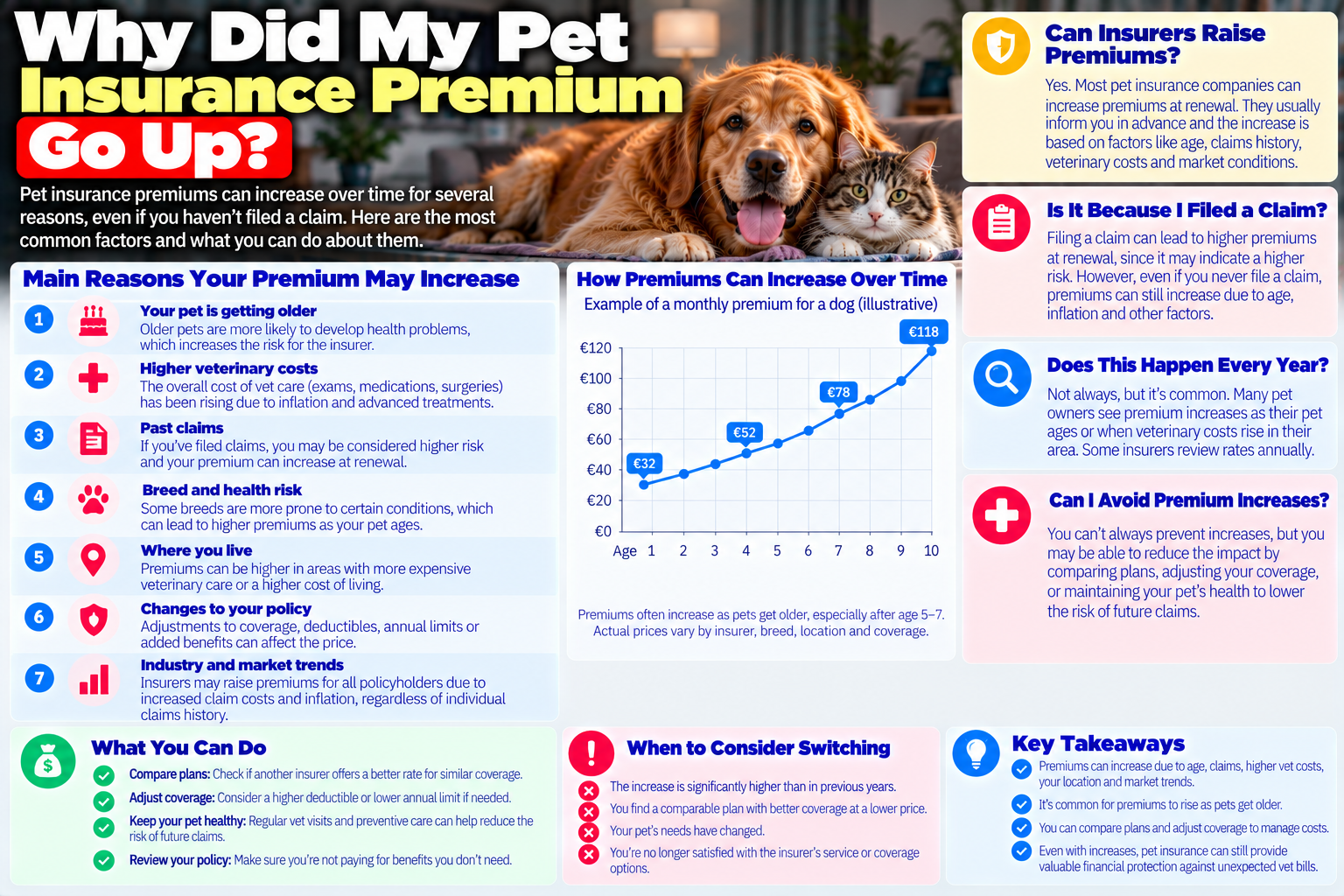
How Much Premiums Have Actually Risen
This isn’t just a feeling — the data backs it up: source
- Average U.S. dog premiums (accident and illness) rose about 22%, from $613/year in 2020 to $749/year in 2024, according to NAPHIA data. Just over half of that increase happened in 2024 alone.
- Average cat premiums rose more slowly — about 5%, from $367 to $386/year over the same period.
- Age compounds this fast: Insurify data shows a 10-year-old dog can cost roughly three times as much to insure as a 1-year-old dog.
- Extreme cases exist: some owners have reported premiums jumping from around $200 to over $1,300 a year — a 581% increase. Though this is far from typical and usually reflects a combination of an aging pet, a claims-heavy policy group, and a steep underlying rate hike.
Whether your own increase is «normal» depends heavily on your pet’s age, breed, location, and insurer. A 35% jump isn’t unusual for an older pet, but the same jump on a young, healthy pet’s policy is worth questioning.
The Real Reasons Your Premium Went Up
- Your pet’s age. By far the biggest factor. Older pets statistically need more care, so insurers raise rates with every birthday. And increases tend to get steeper as your pet ages, not flatter. source
- Claims across all policyholders, not just you. Many insurers price based on the claims experience of your entire risk pool. If other pet owners in your group are filing more or bigger claims, your rate can rise even if you’ve never submitted one.
- Rising veterinary costs. Vet service prices have climbed roughly 4.7% to 5.6% year over year, and about 51% cumulatively over the past five to six years, according to BLS data cited by Insurify. AAHA data shows average vet bills rose over 60% in the past decade. Advanced diagnostics and specialty treatment push bills — and premiums — higher.
- Location and breed. Both factor into pricing, alongside age and the insurer you chose, though insurers don’t always disclose exactly how much weight each carries.
- Your own claims history. Some insurers also factor in your individual pet’s past claims, not just the group’s.
The Teaser-Pricing Trap
Here’s something most new policyholders don’t realize: some insurers deliberately price year-one coverage low to win new customers, then raise it closer to the real cost of covering that pet in later years. As Insurify puts it, «the actual cost of covering that pet is rarely reflected in that first-year premium.»
This is why the quote you got when you first enrolled can feel like a bait-and-switch two or three renewals later. It often isn’t a mistake or an error, it’s how the pricing was designed from the start. The practical takeaway: when comparing insurers, don’t just compare the first-year quote. Ask each insurer directly how pricing typically changes at renewal and whether new-customer pricing differs from what existing customers pay for the same coverage.
How to Actually Lower the Bill
You can’t undo your pet’s age, but you can adjust the policy’s structure to bring the premium back down: source
- Raise your annual deductible. Deductibles typically range from $100 to $1,000 per pet per year. The higher you set it, the lower your monthly premium.
- Choose a higher coinsurance share. Instead of 90% reimbursement, dropping to 80% or 70% lowers the premium, since you’re taking on more of each claim.
- Lower your annual coverage limit. Limits commonly range from $2,500 to $20,000. A lower cap reduces the premium but also caps your maximum payout per year.
- Drop optional add-ons you don’t use. Wellness, exam-fee, and hereditary-condition riders are extras layered on top of base accident-and-illness coverage — each one adds cost.
- Ask about a multi-pet discount. Insuring more than one pet with the same company often earns a discount (commonly around 5%), though availability varies by state.
- Get a renewal-specific comparison quote. Before assuming you’re stuck, get a quote from a competitor based on your pet’s current age and health. Not the artificially low price a first-year customer would see.
- Ask your current insurer directly what’s driving the increase. Some will break down how much is age-related versus rate-related, which tells you whether switching would actually help.
FAQ
Is a 20-30% renewal increase normal? It can be, especially for an older pet or after a claims-heavy year across your insurer’s risk pool. It’s worth questioning only if your pet is young, healthy, and you’ve filed few or no claims.
Will switching insurers actually save me money? Sometimes, but check how the new insurer treats pre-existing conditions first. Anything your current pet has already been diagnosed with may not be covered by a new policy, even if the new quote looks cheaper upfront.
Can I dispute a premium increase with my insurer? You generally can’t dispute the increase itself, since it’s based on actuarial pricing. But you can ask for a breakdown of what’s driving it and request a quote with adjusted deductible, coinsurance, or limit instead of canceling outright.
Does filing a claim guarantee my premium will go up? Not always for an individual claim. But insurers that price based on group claims experience may raise rates across many policyholders if claims rise broadly, regardless of whether you personally filed one.
Should I just drop coverage if the increase is too steep? Think carefully first. Dropping and re-enrolling later (with this insurer or another) means any condition diagnosed in the meantime becomes pre-existing and excluded going forward. Adjusting your policy’s structure is usually safer than dropping it entirely.
Bottom Line
Your pet’s age, rising vet costs, and your insurer’s own pricing strategy. Not something you did wrong — are almost always behind a renewal increase. You can’t reverse the age factor. But raising your deductible, lowering your reimbursement rate or coverage limit, and getting a real renewal-based comparison quote can meaningfully bring the bill back down. If you’re weighing whether to switch entirely, see our guide on whether and when to switch pet insurance.
Sources
- The Zebra – Why Did My Pet Insurance Go Up at Renewal?
- Insurify – Pet Insurance Rates Can Soar at Renewal
- AKC Pet Insurance – How to Lower Your Pet Insurance Premiums
Sources
Key Takeaways on Pet Insurance Premium Go Up
- Your pet’s age is the biggest driver of a renewal increase, and premiums typically rise every year as pets get older.
- Rising vet costs push prices up as well, and you cannot control that part.
- If the increase is large, get fresh quotes, but check how a switch would treat existing conditions.
By Joaquín Benicio Conforti · Last updated: October 2026