Looking for answers on pet insurance vs savings account? Here is what the numbers and the fine print really say. Quick answer: There’s no universal winner. It depends on your pet’s age, your risk tolerance, and how disciplined you are about actually funding the account. Insurance wins if your pet is young and healthy (lower premiums, no waiting to build a fund) or if a major illness strikes early. A dedicated savings account wins if you’re highly disciplined, your pet is unlikely to need expensive care. You can tolerate the risk of a big bill hitting before you’ve saved enough.
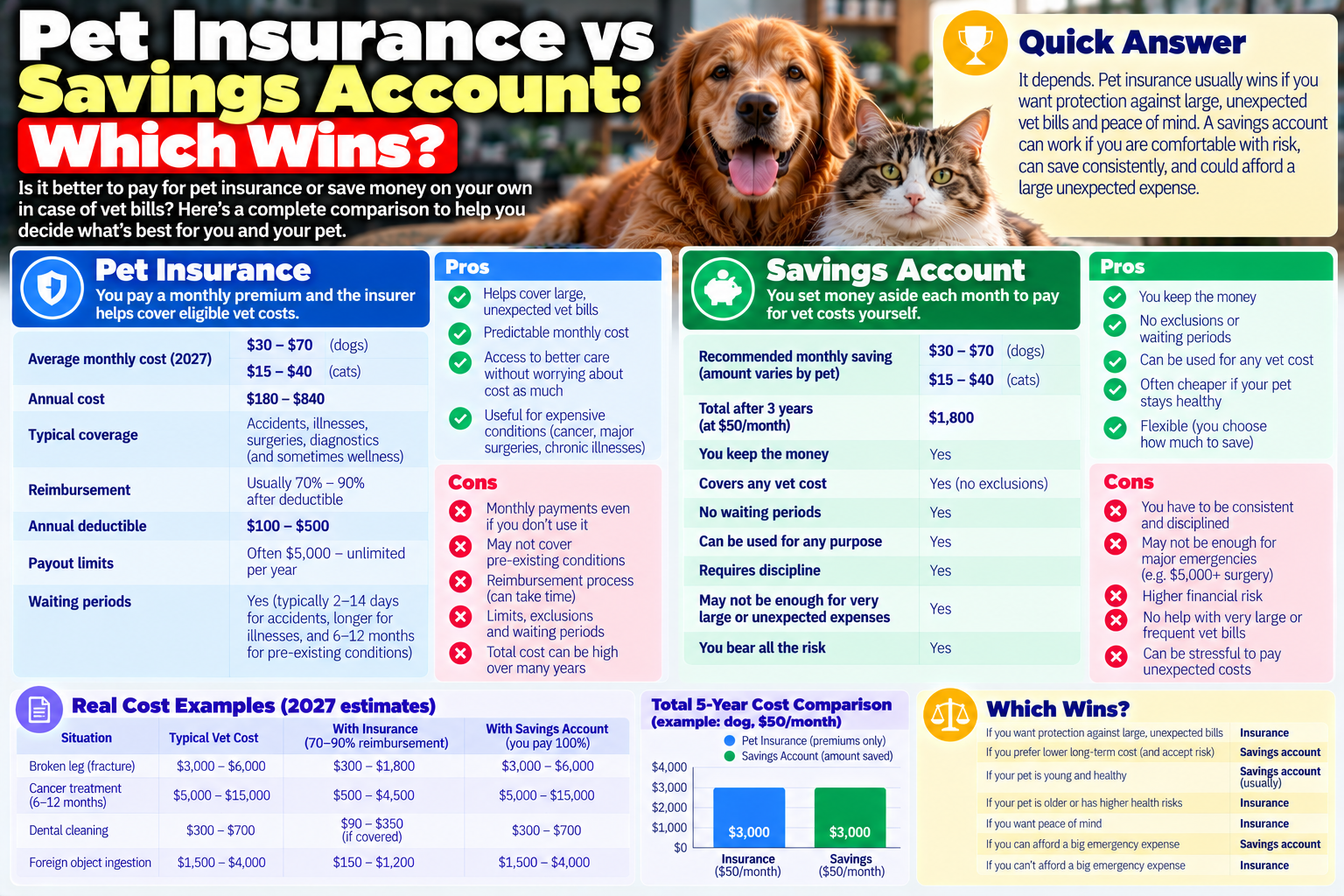
Side by Side
| Pet insurance | Savings account | |
|---|---|---|
| Coverage starts | Immediately after waiting period, even with $0 saved | Only once you’ve actually saved enough |
| Monthly cost | ~$43/mo avg. for dogs, ~$23/mo avg. for cats (2026 national average) | Whatever you choose to deposit — flexible |
| Who controls the money | Insurer decides what’s «eligible»; pre-existing conditions excluded | You control it completely, spend it on anything |
| Payout speed | Usually pay upfront, wait days to weeks for reimbursement (a few insurers offer direct vet pay) | Instant — you already have the cash |
| If your pet stays healthy | You’ve paid premiums with nothing to claim | You keep every dollar, plus any interest earned |
| If your pet has a major illness early | Covered (after waiting period), regardless of how much you’ve paid in | You’re on your own until the fund is big enough |
Both options are really answering the same question — «how do I pay for a bill I can’t predict?». Just with different tradeoffs between certainty and flexibility. source
The Math: What Your Savings Account Has to Beat
Say you redirect the same amount a typical insurance premium would cost — about $43/month for a dog — into a dedicated savings account instead. source
| Time saving | Amount banked (no interest, illustrative) |
|---|---|
| 6 months | ~$258 |
| 12 months | ~$516 |
| 24 months | ~$1,032 |
| 36 months | ~$1,548 |
Now compare that to what Trupanion’s own claims data shows: a single vet visit for something as ordinary as vomiting «can easily cost around $1,100,» and 45% of the claims Trupanion sees are for over $1,000. A foreign-body removal or a torn ACL (see our surgery cost guide) can run $3,000-$10,000 — several years of banked premiums, all at once.
The savings account wins financially only if your pet stays healthy long enough for the balance to outgrow what insurance would have paid out. The math flips hard the moment a major claim lands early.
The Timing Problem Nobody Plans For
The risk with a DIY emergency fund isn’t that it doesn’t work — it’s that emergencies don’t wait for your fund to be ready. A puppy or kitten can swallow a sock, get hit by a car, or develop a congenital condition in year one, long before 24-36 months of $43 deposits have piled up.
Insurance sidesteps this entirely: coverage applies the same whether your claim comes in month 2 or year 10, as long as it’s past the policy’s waiting period (typically 14-30 days for illness, shorter or immediate for accidents, depending on the insurer). A savings account offers no such floor. If the bill hits in month 3, you have whatever you’ve managed to save in month 3, nothing more.
Surveys cited in industry research have found that over half of pet owners have skipped or declined vet-recommended care because of cost. Which is exactly the scenario a half-built emergency fund leaves you in.
Who Each Option Actually Fits
Pet insurance tends to fit:
- Puppies and kittens, since premiums are cheapest at a young age and you’re covered before anything pre-existing can exclude a condition
- Breeds prone to expensive hereditary or breed-specific conditions (hip dysplasia, bloat, cruciate tears)
- Owners who want cost certainty and would struggle to produce $3,000-$10,000 on short notice
A savings account tends to fit:
- Owners with genuine financial discipline who will fund it consistently, not just in theory
- Pets already past the age where insurance premiums are cheap, where self-insuring may pencil out better
- Anyone who already has a comfortable emergency fund and can treat a vet bill as one more line item
The hybrid approach many owners land on: carry accident-and-illness insurance while your pet is young (when premiums are lowest and you’re covered before conditions become pre-existing), and build a smaller cash buffer alongside it for the deductible and any non-covered costs like routine wellness care.
FAQ
Can I do both — insurance and a savings account? Yes, and many owners do. Insurance handles the unpredictable big bill; savings cover the deductible, routine wellness care, and anything insurance excludes.
What if my pet never gets sick. Did I waste money on insurance? In pure dollar terms, yes, you’ll have paid more in premiums than you claimed. The tradeoff you bought was certainty, not a guaranteed financial win — the same logic applies to any insurance (home, auto, health).
Does a high-yield savings account change the math much? It helps a little. Interest adds up over years — but it doesn’t solve the timing problem. A 4-5% APY on $500 earns about $20-25 a year, nowhere near enough to offset an early $3,000 emergency.
How much should I keep in a pet emergency fund if I also have insurance? Enough to cover your deductible plus a cushion for anything not covered. Commonly $500 to $1,500, depending on your plan’s deductible and what it excludes.
Is it ever too late to switch from savings to insurance? No. But premiums rise with age and any condition that develops before you enroll becomes pre-existing and excluded. The earlier you add insurance, the more of your pet’s future health is actually covered.
Bottom Line
A savings account is cheaper on average if your pet stays healthy, but insurance wins the moment a major bill lands early. And that’s the scenario a half-funded emergency fund can’t handle. If you’re disciplined and your pet is already older with a lower claim risk, self-insuring can make sense. Otherwise, insuring young and pairing it with a smaller cash cushion for deductibles and non-covered costs is the approach that protects you against both outcomes.
Sources
Key Takeaways on Pet Insurance Vs Savings Account
When you weigh pet insurance vs savings account, the right choice comes down to your pet’s age, health and your monthly budget. Before you commit to pet insurance vs savings account, compare at least three written quotes and read the exclusions line by line. The main takeaway on pet insurance vs savings account is simple: match the plan to the risks you cannot afford to cover yourself.
Keep these points about pet insurance vs savings account in mind, and revisit your decision every year at renewal. Good decisions about pet insurance vs savings account start with real quotes, not averages, so run the numbers for your own pet. If pet insurance vs savings account still feels confusing, write down your budget, your deductible and your must-have coverage first.
When you weigh pet insurance vs savings account, the right choice comes down to your pet’s age, health and your monthly budget.
Last updated: October 2026