Quick answer
Pet insurance with no annual limit removes the ceiling on what the insurer pays in a year, and only some insurers offer it. Which pet insurers offer no annual limit? Healthy Paws and Trupanion offer unlimited annual and lifetime payouts on every plan (see our Healthy Paws review) (see our Trupanion review). ASPCA, Spot, MetLife, and Pumpkin also offer an unlimited annual tier, though usually at a higher price point than their capped plans, and none of those four states a true unlimited lifetime payout the way Healthy Paws and Trupanion do.
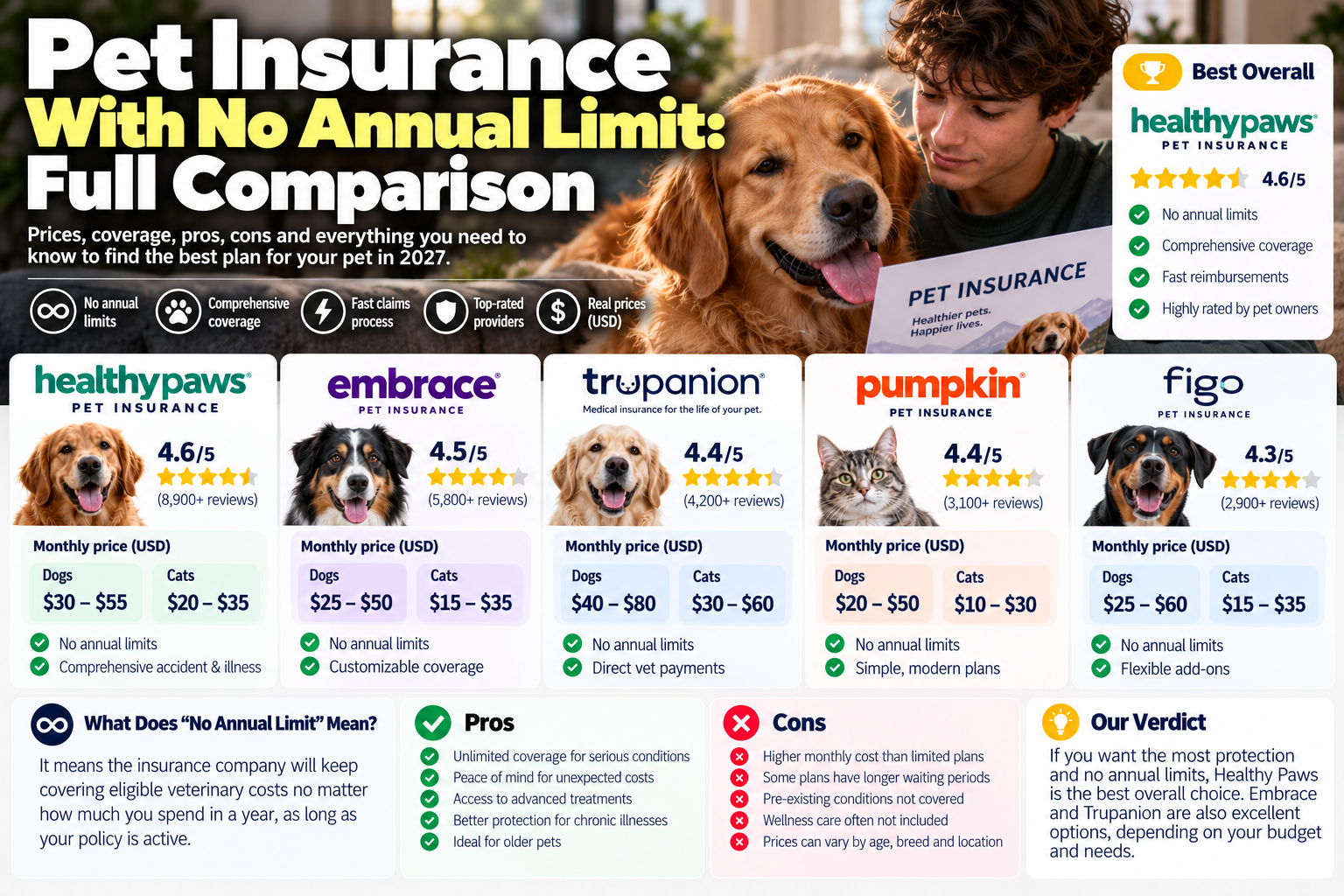
«Unlimited» sounds like a single feature, but it actually comes in two flavors. Unlimited per year and unlimited over your pet’s lifetime — and the difference matters a lot for a pet with a long chronic illness.
Insurers that offer unlimited coverage
| Insurer | Unlimited annual? | Unlimited lifetime? | Reimbursement | Deductible range | Sample monthly rate (dog/cat) |
|---|---|---|---|---|---|
| Healthy Paws | Yes, standard | Yes, standard | 50%–90% | $100–$1,000 | ~$48 / ~$23 |
| Trupanion | Yes, standard | Yes, standard | 90% (one tier) | $0–$1,000 (per condition) | ~$79 / ~$28 (at $500 ded.) |
| ASPCA | Yes, an option | Not stated | 70%, 80%, or 90% | $100–$750 | ~$39 / ~$19 |
| Spot | Yes, an option | Not stated | 70%, 80%, or 90% | $100–$1,000 | ~$35 / ~$17 |
| MetLife | Yes, an option | Not stated | 50%–90% | $0–$2,500 | ~$53 / ~$24 |
| Pumpkin | Yes, an option | Not stated | 80% or 90% | $100–$1,000 | ~$32 / ~$15 |
Sample rates are illustrative quotes for a young, healthy pet and will vary by breed, age, and location. Only Healthy Paws and Trupanion build unlimited coverage into every plan by default; the rest offer it as a selectable tier at an added cost.
Annual unlimited vs. lifetime unlimited: why it matters
An annual unlimited plan removes the cap on how much it pays out in a single policy year. But some insurers still track a lifetime maximum behind the scenes, or simply don’t publish one. Meaning it’s unclear what happens if a pet needs expensive care year after year for a decade.
A lifetime unlimited plan removes that ceiling entirely, for as long as you keep the policy active. This is the feature that actually matters for a chronic, multi-year condition: diabetes managed for 8 years, ongoing cancer treatment, or a degenerative joint disease that needs surgery now and physical therapy for years afterward.
Of the insurers in the table above, only Healthy Paws and Trupanion are explicit that both the annual and lifetime maximums are unlimited on every plan. The others (ASPCA, Spot, MetLife, Pumpkin) advertise an unlimited annual option but don’t make the same lifetime claim. Worth confirming directly with the insurer if a long-term condition is your main concern.
When unlimited coverage is actually worth paying for
Unlimited coverage earns its higher premium in a specific set of situations:
- Breeds prone to hereditary or chronic conditions. Hip dysplasia in large breeds like Golden Retrievers, heart disease in Maine Coons, or other breed-linked conditions that tend to need ongoing, expensive management
- Major surgery — a torn cruciate ligament (ACL) repair alone can run $3,000–$8,000+ depending on location and complexity
- Ongoing chronic illness — cancer treatment, diabetes management, or kidney disease that requires years of recurring vet visits and medication
- Older pets — veterinary costs tend to climb as pets age. A capped plan’s annual limit can get exhausted faster on a senior pet (see how pet insurance deductibles work)
- One catastrophic emergency — even a single serious accident or sudden illness can blow past a $5,000–$10,000 annual cap in a single vet visit
For a young, healthy pet with no known risk factors and a budget that matters more than peace of mind, a capped plan with a generous limit (say, $15,000–$20,000/year) is usually enough and meaningfully cheaper.
The tradeoffs of going unlimited
Removing the payout cap doesn’t come free:
- Higher premiums. Both Healthy Paws and Trupanion, which build unlimited coverage into every plan, run above the industry average monthly premium. You’re paying for the safety net whether you use it or not.
- Premiums climb faster with age. Insurers that offer unlimited payouts tend to raise rates more aggressively as pets get older, since their own payout risk grows with age too.
- No wellness coverage, in some cases. Healthy Paws, for example, doesn’t offer any wellness/preventive add-on at all. Unlimited coverage and routine-care bundling rarely come from the same insurer.
- Longer or stricter waiting periods on specific conditions. Trupanion’s waiting periods run a bit longer than some capped competitors, and orthopedic conditions often carry extended waits across the board.
- The cap you’re avoiding may rarely matter anyway. Most claims never get close to a $15,000+ annual limit. You’re paying extra for protection against a less common, worst-case scenario.
How to choose, and FAQ
- Check your breed’s risk profile. A breed prone to hip dysplasia, heart disease, or cancer benefits most from unlimited lifetime coverage.
- Think in years, not just this year. A capped plan’s annual limit resets every year. So what matters for a chronic illness is the cumulative multi-year cost, not any single year’s bill.
- Compare Healthy Paws and Trupanion directly if true lifetime-unlimited coverage is the priority — they’re the two insurers making that explicit promise.
- Get real quotes for your pet’s age and breed, since «unlimited» insurers often price in that risk through higher premiums that climb faster with age.
FAQ
Is unlimited coverage worth the higher premium for a healthy young pet? Not always. If your pet has no known breed-linked risks, a capped plan with a high limit (around $15,000–$20,000/year) often covers everything realistic for meaningfully less money.
Do all «unlimited» plans mean the same thing? No. Some insurers only remove the annual cap while staying vague on lifetime totals; only a couple explicitly promise unlimited for both.
Does unlimited coverage include pre-existing conditions? No. Unlimited payout limits never override the pre-existing condition exclusion — that’s a separate rule every insurer applies (see pet insurance for pre-existing conditions).
Will my premium still rise even with unlimited coverage? Yes. Premiums on unlimited plans typically increase as your pet ages, sometimes more sharply than on capped plans.
Bottom line
Unlimited coverage is real and valuable, but it’s not a single standardized feature — some insurers only remove the annual cap. Meanwhile, Healthy Paws and Trupanion are the clearest about removing the lifetime cap too. For a pet with real risk factors (breed, age, a chronic diagnosis), that distinction can be worth hundreds of dollars a year in premium. For a young, low-risk pet, a generously capped plan usually delivers similar protection for less.
Compare quotes from at least one unlimited-annual insurer and one true unlimited-lifetime insurer before deciding.
Sources
- Best Pet Insurance Companies for 2026 — NerdWallet
- Unlimited Pet Insurance Coverage — comparison roundup, October 2026
Sources
- Best Pet Insurance Companies for 2026 — NerdWallet — nerdwallet.com
Key Takeaways on Pet Insurance With No Annual Limit
- Healthy Paws and Trupanion offer unlimited annual and lifetime payouts on every plan.
- Higher limits cost more, so pick one that matches your risk tolerance.
- Read the fine print on any other limits, such as per-condition caps.
By Joaquín Benicio Conforti · Last updated: October 2026