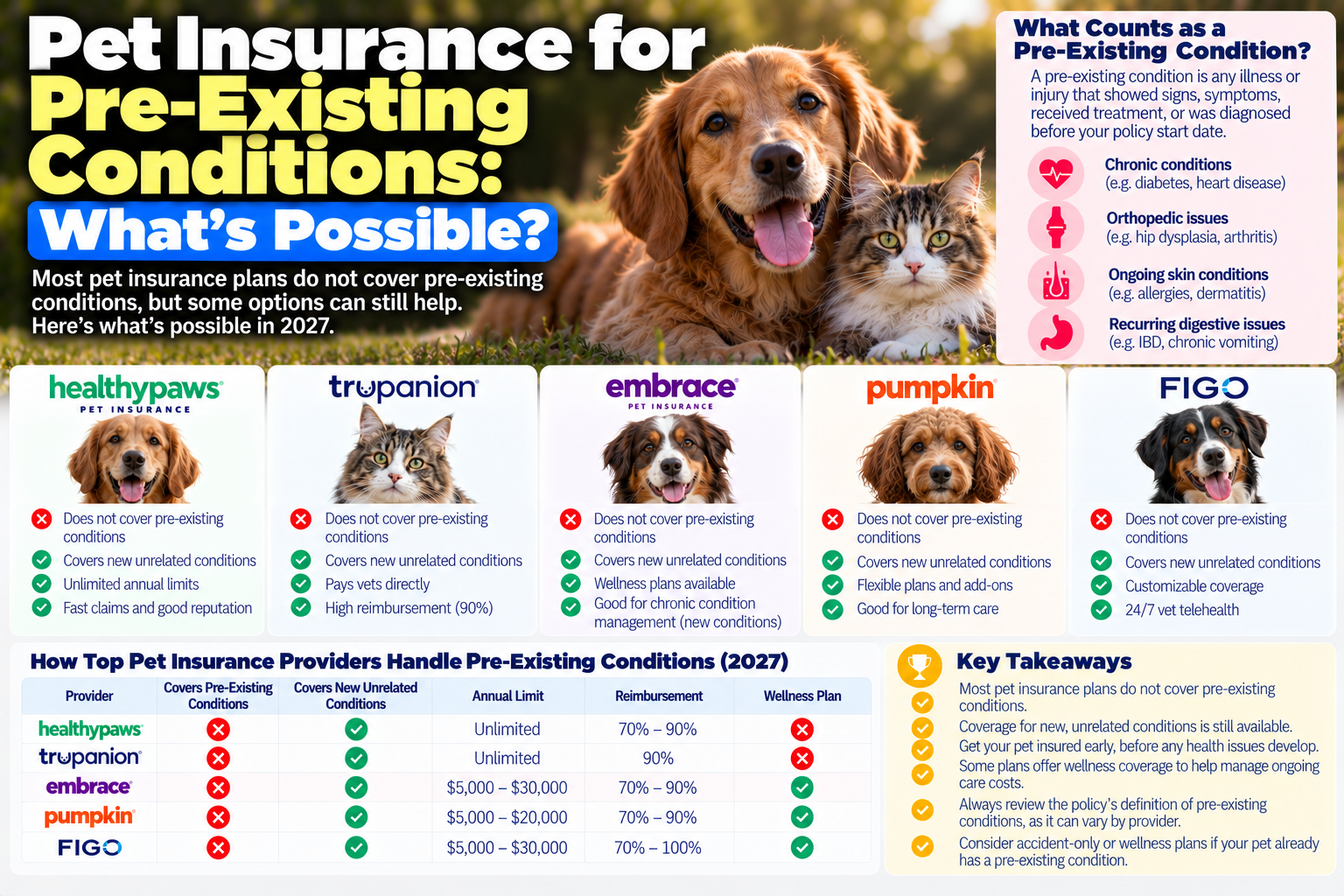
Pet insurance for pre-existing conditions is limited, but a few insurers make exceptions for curable problems. Quick answer: Almost no pet insurer covers a pre-existing condition outright. But several — ASPCA, Hartville, Pumpkin, and Spot among them. Will cover a curable condition again once your pet has gone symptom-free for 180 days to a year. Incurable conditions like diabetes, cancer, or arthritis are almost never covered once diagnosed, with AKC Pet Insurance as a rare, state-limited exception.
What counts as pre-existing, and why curable vs. incurable matters
A pre-existing condition is any illness or injury that started before your policy’s effective date. Including anything that first shows symptoms during the waiting period, even if it isn’t formally diagnosed until later. Accident and illness plans exclude these by default; wellness add-ons generally still cover preventive care regardless.
Insurers split pre-existing conditions into two categories, and this is the distinction that decides whether you’ll ever get coverage back:
- Curable conditions fully resolve with treatment — a urinary tract infection, a respiratory infection, a broken bone. Several insurers will cover these again once your pet has gone a set number of days with no symptoms and no treatment.
- Incurable conditions are lifelong or have no cure — allergies, diabetes, cancer, arthritis, chronic kidney disease. These are almost never covered once diagnosed, no matter how much time passes (see what pet insurance doesn’t cover).
Insurers that may cover curable pre-existing conditions
| Insurer | Symptom-free period required | Notes |
|---|---|---|
| ASPCA | 180 days | Symptom- and treatment-free; knee/ligament issues never covered |
| Hartville | 180 days | Knee and ligament problems never covered regardless of timing |
| Pumpkin | 180 days | Knee and hind-leg ligament problems excluded (see Embrace vs Pumpkin) |
| Spot | 180 days | Knee/ligament conditions excluded if they occurred before the start date or during the waiting period |
| Nationwide | At least 6 months | Requires a requested review — coverage isn’t automatic |
| Embrace, Figo, Healthy Paws, Lemonade, Prudent Pet | 12 months | Generally require a full year symptom-free for curable conditions (see our Healthy Paws review) |
| AKC Pet Insurance | 365 consecutive days | The only insurer found to cover some incurable conditions too, and only in certain states |
Across the board, knee and ligament conditions (like a torn ACL/CCL) are the one category insurers almost never reclassify as cured, even after a long symptom-free stretch.
Waiting periods make this worse than it looks
Every policy has its own waiting period before coverage starts, and anything that shows symptoms during that window gets classified as pre-existing. Even though you were already paying premiums:
- Accidents: usually 1–15 days; MetLife and Lemonade cover accidents immediately
- Illness: usually 14–30 days; most insurers use 14–15 days, Trupanion uses 30 (see our Trupanion review)
- Orthopedic conditions: often six months or longer, sometimes for dogs only — Embrace can shorten this to 14 days with a vet orthopedic exam. Meanwhile, Healthy Paws waits a full 12 months for hip dysplasia and only covers pets enrolled before age 6
The practical effect: a symptom that appears in week two of a 30-day illness waiting period locks that condition out as pre-existing before your coverage has even technically started.
How to improve your odds
- Ask for a medical history review if the insurer offers one. It tells you exactly what will be classified as pre-existing before you commit to a plan
- Expect a baseline vet exam at enrollment. Insurers use it to document your pet’s health at that moment, which becomes the reference point for any future dispute
- Never let your policy lapse. If coverage lapses and you reinstate it later, a condition diagnosed in the gap. Or even one that was previously covered — can be reclassified as pre-existing. Autopay is the simplest safeguard
- Watch for paired-organ exclusions. If one knee, hip, or eye was affected, several insurers will also exclude the matching one on the other side, even if it’s never shown a symptom
- A workplace MetLife group plan can sometimes preserve prior coverage for conditions your previous individual plan already covered, which is worth checking if you’re switching jobs or insurers
FAQ
Does any pet insurance cover pre-existing conditions? Not outright. A handful of insurers will cover a curable pre-existing condition again after a symptom-free period of 180 days to a year. But incurable conditions are almost never covered once diagnosed.
What is considered a curable pre-existing condition? An illness or injury that fully resolves with treatment. Common examples include urinary tract infections, respiratory infections, and simple fractures. Chronic or lifelong conditions like diabetes, cancer, and arthritis don’t qualify.
Can I get pet insurance if my pet already has a condition? Yes. You can still enroll and get coverage for everything unrelated to that condition. The existing condition itself just won’t be covered unless it’s curable and later resolves.
How long is the waiting period for pre-existing conditions? There’s no waiting period that unlocks a pre-existing condition directly. Instead, insurers require a symptom-free stretch — typically 180 days to 12 months — before they’ll reconsider a curable condition as newly insurable.
Bottom line
Pre-existing condition coverage is the single biggest gap in pet insurance, and the fine print varies more here than on almost any other feature. If your pet already has a diagnosed condition, don’t assume you’re uninsurable — you’ll still get coverage for everything else. A curable condition can come back into coverage after enough symptom-free time. The real lesson is to enroll before anything shows up on a vet record at all, since prevention beats every workaround insurers offer after the fact.
Sources
- 6 Best Pet Insurance Companies for Pre-Existing Conditions — NerdWallet
- Pet Insurance Waiting Periods: What You Need to Know — NerdWallet
Key Takeaways on Pet Insurance For Pre-Existing Conditions
- Almost no insurer covers a pre-existing condition outright.
- ASPCA, Hartville, Pumpkin and Spot can cover a curable condition again after a symptom-free period.
- Keep your pet’s vet records, since they decide what counts as pre-existing.
By Joaquín Benicio Conforti · Last updated: October 2026