Quick answer: A typical accident-and-illness premium runs about $40-$46/month for an adult dog and $21-$22/month for an adult cat. But age is the single biggest multiplier — a senior dog averages around $116/month and a senior cat around $62/month. Breed, state, deductible, and reimbursement percentage each shift the number further. Use the ranges below to build your own estimate, or plug your pet’s details into the pet insurance calculator above.
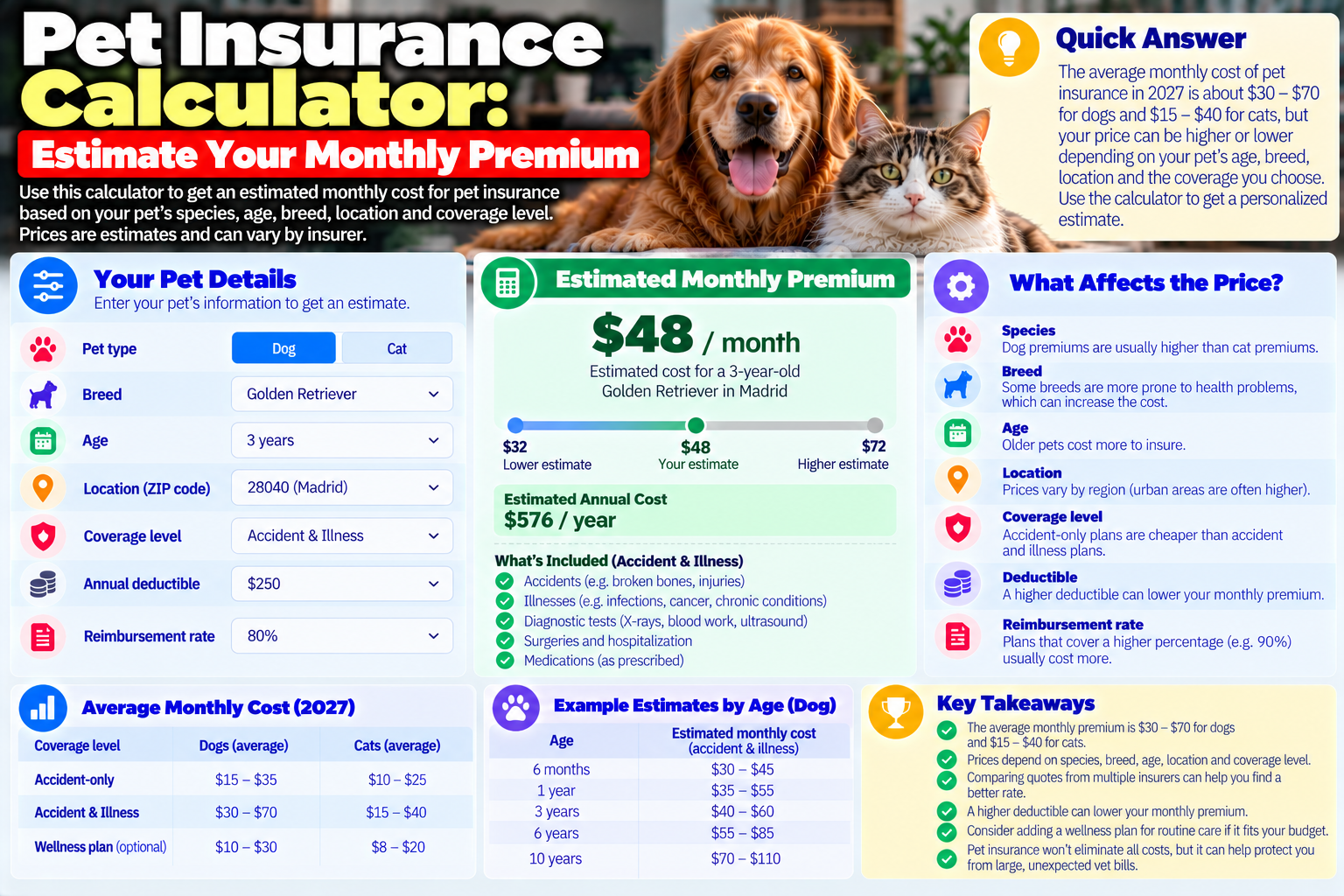
Estimate your monthly premium
Answer six quick questions. Nothing is stored or sent anywhere.
This is an estimate built from published average prices for accident-and-illness plans, not a quote or an offer of insurance. Real premiums depend on each insurer’s underwriting, your ZIP code and the exact plan. Always get official quotes before you buy.
How This Pet Insurance Calculator Works
Your actual quote comes from the insurer’s own underwriting, but every pet insurance premium is built from the same handful of inputs:
- Species and age — by far the largest factor; a senior pet’s premium can be 2-3x a young adult’s.
- Breed — breeds prone to hereditary or costly conditions (certain bulldogs, large-breed dogs, Maine coons) price higher than lower-risk breeds.
- Location (state, sometimes ZIP code) — reflects local vet costs, which vary significantly across the US.
- Deductible — the amount you pay out of pocket before coverage kicks in each policy year; a higher deductible lowers your premium.
- Reimbursement percentage — the share of each covered bill the insurer pays back; a lower percentage (say 60% instead of 90%) lowers your premium.
- Annual coverage limit — a lower cap on yearly payouts also lowers the premium.
Stack your pet’s numbers against the tables below to build a realistic estimate before you request real quotes.
Cost by Age — the Biggest Factor
| Life stage | Dogs (monthly) | Cats (monthly) |
|---|---|---|
| Puppy / Kitten | $40 | $21 |
| Adult | $46 | $22 |
| Senior | $116 | $62 |
Source: Insurify’s 2026 average pricing data for accident-and-illness plans. source
The jump from adult to senior pricing is dramatic — roughly 2.5x for dogs and nearly 3x for cats. Which is why enrolling while your pet is young locks in years of lower premiums before age-based increases compound. Note that many insurers won’t enroll kittens under 8 weeks old or dogs older than 14. Some only offer accident-only coverage (not full accident-and-illness) once a pet reaches a certain age.
Cost by Breed
| Breed | $5,000 annual coverage | Unlimited annual coverage |
|---|---|---|
| Golden Retriever (dog, lower-cost example) | $59/mo | $115/mo |
| French Bulldog (dog, higher-cost example) | $69/mo | $134/mo |
| Ragdoll (cat, lower-cost example) | $26/mo | $58/mo |
| Maine Coon (cat, higher-cost example) | $30/mo | $58/mo |
Breed pricing reflects each breed’s statistical likelihood of hereditary or costly conditions. French bulldogs, for instance, are prone to brachycephalic airway issues and spinal conditions that drive up expected claims, which insurers price in from day one. For deeper breed-specific numbers, check our dedicated By Breed coverage guides.
Cost by State, Deductible, and Reimbursement
By state (monthly average, dogs and cats):
| Lowest | Highest | |
|---|---|---|
| Dogs | Alabama / Mississippi — $32 | Alaska — $66; Massachusetts — $64 |
| Cats | Mississippi — $11 | Washington, D.C. — $34; Delaware — $32 |
Premiums can even vary by ZIP code within a state. Higher-density, higher-cost-of-living areas generally see higher rates, since local vet pricing feeds directly into the premium. See our state-by-state pricing guide for your specific state.
Deductible and reimbursement:
- Deductible: Typically $100 to $1,000 per pet per year. A higher deductible lowers your monthly premium but increases what you pay out of pocket before coverage starts.
- Reimbursement rate: Typically 60% to 100%. Choosing a lower rate (say 60% instead of 90%) lowers your premium, but you cover a larger share of every claim.
These two levers are the easiest way to fine-tune a quote up or down without changing insurers. See our guide on lowering your premium for how much of a difference each adjustment typically makes.
FAQ
Why is my actual quote different from this calculator’s estimate? These figures are national averages. Your real quote also factors in your pet’s individual health history, the specific insurer’s underwriting model, and sometimes your exact ZIP code. Use this page to sanity-check a quote, not replace one.
What’s the single biggest thing I can do to lower my estimate? Enroll while your pet is young. Age is the largest factor by far, and premiums only climb from there. You can’t «buy back» the lower rate once your pet ages into the senior bracket.
Does a mixed-breed pet cost less to insure than a purebred? Often, yes, since mixed breeds may avoid some purebred-specific hereditary risk pricing, though it depends heavily on the specific mix. See our mixed-breed dog insurance guide for the details.
Should I choose the highest reimbursement rate I can afford? Not necessarily — it depends on your risk tolerance. A high reimbursement rate costs more monthly but pays back more per claim. A lower rate saves monthly but means you cover more of each bill yourself.
Is wellness coverage included in these estimates? No, these are accident-and-illness base rates. Wellness or preventive-care riders are optional add-ons priced separately and would raise the total shown here.
Bottom Line
Age drives the estimate more than any other factor, followed by breed, location, and the deductible/reimbursement combination you choose. Use the tables above to sanity-check any quote you get, and enroll while your pet is young to lock in the lowest realistic premiums before age-based increases compound. For a specific number, compare real quotes from two or three insurers using your pet’s actual age, breed, and ZIP code.
Sources
Key Takeaways on Pet Insurance Calculator
Before you decide on pet insurance calculator, get at least three quotes and compare them using the same deductible, reimbursement rate and annual limit. The right answer on pet insurance calculator depends on your pet’s age and health, your budget and how much risk you are comfortable carrying yourself. Read the exclusions and waiting periods carefully, because that fine print matters more than the monthly price when you look at pet insurance calculator.
Revisit pet insurance calculator every year at renewal, since premiums and coverage rules change. If you are still unsure about pet insurance calculator, start with the calculator on this site and then request official quotes. Use this guide as a starting point for pet insurance calculator, and confirm current terms with the insurer before you buy.
By Joaquín Benicio Conforti · Last updated: October 2026