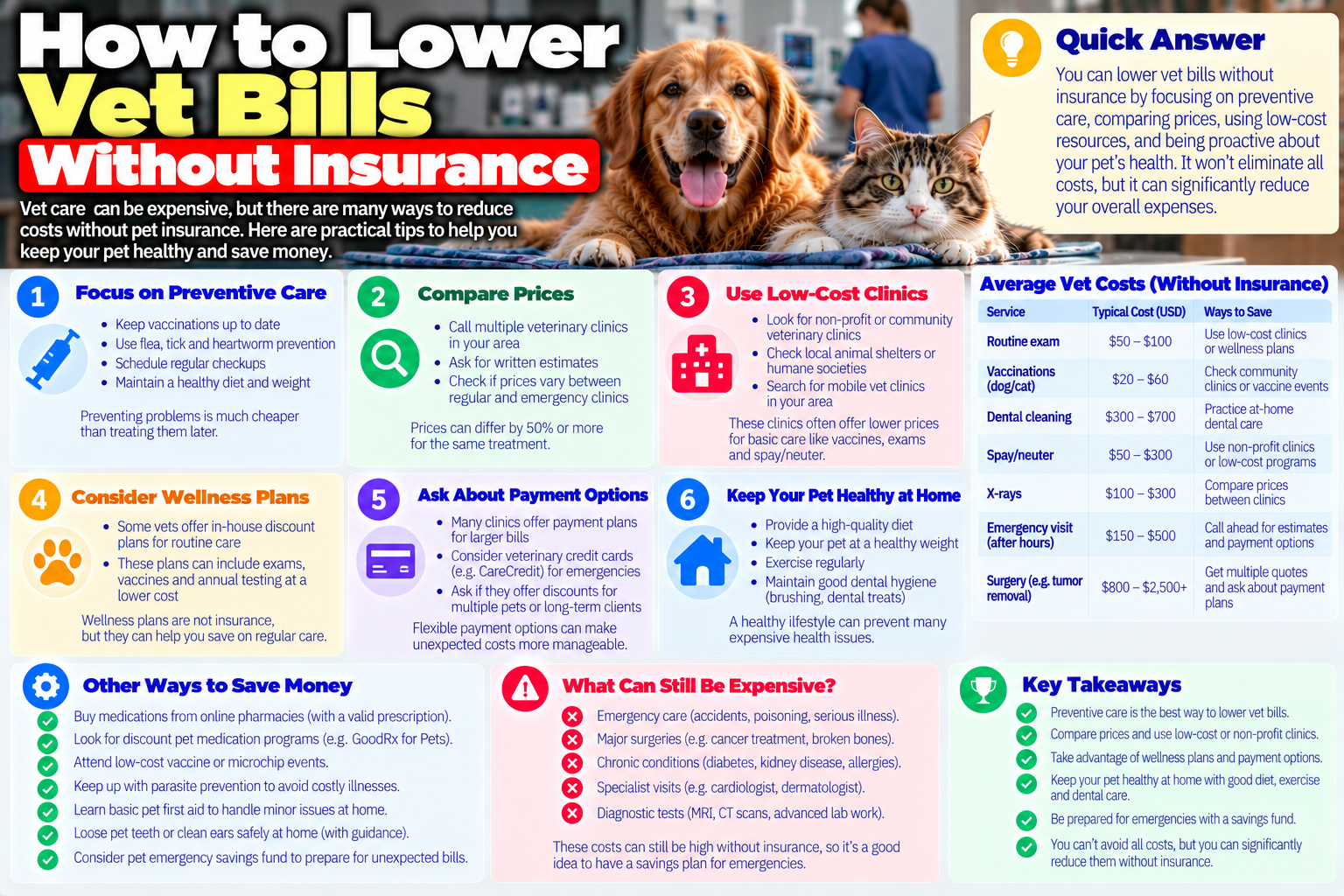
This guide explains how to lower vet bills without insurance. Quick answer: The biggest savings come from preventive care (catching problems early is always cheaper than treating advanced disease), price-shopping medications and food, asking directly about payment plans or wellness bundles, and knowing which nonprofit programs. Like RedRover Relief’s urgent care grants — can help if a bill turns into a genuine emergency. None of this replaces insurance for a major surgery, but together these tactics meaningfully cut routine and moderate costs.
Prevention Is the Cheapest Treatment
The single biggest lever you control is catching problems before they become expensive: source
- Keep up annual exams, bloodwork, and vaccines. Catching a condition early is consistently cheaper than treating advanced illness. A routine checkup costs a fraction of what a late-stage diagnosis does.
- Stay current on heartworm prevention. The monthly preventive is far cheaper than treating a heartworm infection once it takes hold.
- Keep your pet at a healthy weight. Smaller portions or a better diet now reduce the odds of costly weight-related conditions (joint problems, diabetes, heart strain) later.
- Ask about your vaccine schedule. Some core vaccines, like parvo and distemper, can protect for at least three years in adult pets after the initial puppy or kitten series. Ask your vet whether annual boosters are truly necessary for your pet or whether a longer interval is appropriate.
- Keep up dental care and spay/neuter. Both prevent far more expensive problems (extractions, pyometra, certain cancers) down the line.
Shop Around — Most Owners Don’t
- Compare medication prices before filling a prescription at the vet’s own pharmacy. Human pharmacies often carry the same medications cheaper. Costco is frequently among the lowest, and some pharmacies offer AAA member discounts. You’ll still need your vet’s prescription or authorization either way.
- Use a reputable online pharmacy for recurring prescriptions, but avoid buying things like heartworm preventives from unverified marketplace sellers (the article specifically flags Amazon third-party listings as a risk). Counterfeit or mishandled product is a real concern with prescription pet medication.
- Buy food in bulk and watch for sales, and check whether local shelters or community programs offer free or discounted pet food.
- Search specifically for «low-income» or «reduced-cost» veterinary clinics in your city. These exist in most metro areas and often require only basic income documentation, not a lengthy application.
- Ask about wellness plans. Many clinics bundle routine services (exams, vaccines, dental, bloodwork) into a discounted monthly or annual package. Worth comparing against paying for each visit separately.
Talk to Your Vet About Money — Directly
Most owners don’t ask, and most vets expect the question more than you’d think.
- Request a written estimate before any treatment. This avoids surprise charges and lets you ask what’s negotiable before, not after, the work is done.
- Ask about lower-cost treatment options, with the real risks and benefits of each. There’s often a cheaper, clinically reasonable path that your vet won’t offer unless you ask. Not because they’re hiding it, but because the «gold standard» option is the default conversation.
- Ask directly about payment plans. Many clinics, especially larger hospitals, offer in-house installment plans for bills they didn’t volunteer upfront.
- Ask about CareCredit or similar financing. It often comes with no fees or interest for an initial promotional period if paid off in time (see our full CareCredit breakdown for the fine print on how that actually works).
- In genuinely tight situations, ask about bartering or a sliding scale. Not every clinic offers this. But some do, especially smaller independent practices — it costs nothing to ask.
When It’s a Real Emergency: Financial Assistance Programs
RedRover Relief Urgent Care Grants are worth knowing about before you need them: source
- What it covers: A small gap in funding for a pet with a life-threatening injury or illness that has a good expected outcome. It’s designed to get treatment started, not fund an entire course of care.
- Typical amount: Around $250-$300 on average; it generally can’t help if the total needed is $500 or more.
- Eligibility: Household income of $60,000/year or less, US residency, and a vet-provided diagnosis, treatment plan, and cost estimate. It does not cover office exams, diagnostics/testing, routine care, follow-ups, or treatment that’s already mostly complete.
- How to apply: Pass a quick pre-application eligibility check, then complete the full application. Submissions are reviewed in order received, with replies typically in 1-2 business days; the window closes Fridays at 4 p.m. Pacific and reopens Mondays at 9 a.m. Pacific.
Other places to look:
- Local shelters and humane societies often maintain their own emergency funds or know which nearby clinics offer reduced-cost emergency care.
- Breed-specific rescue groups sometimes help with emergency bills for dogs of their breed, even if you didn’t adopt through them.
- A directory search (terms like «pet financial assistance» plus your state) turns up regional nonprofits that national lists miss.
FAQ
Can I really get the same medication cheaper at a human pharmacy? Often, yes, for medications that aren’t pet-specific. But you still need your vet’s prescription or written authorization, and some medications are only available through veterinary channels.
Are low-cost vet clinics lower quality? Not inherently. Many are run by licensed vets and simply operate on tighter margins, sometimes with nonprofit or municipal support, or by limiting services to high-volume routine care rather than specialty treatment.
What if I can’t afford an emergency bill right now? Tell the clinic immediately, before you’re asked to pay. Ask about a payment plan, check RedRover Relief’s eligibility, and ask the clinic directly whether they know of other local assistance programs.
Is skipping annual vaccines a good way to save money? Only with your vet’s input. Core vaccines may protect longer than one year in adults. But skipping recommended vaccines without checking first can leave your pet unprotected and lead to a much costlier illness later.
Should I just avoid the vet to save money? No. Delaying care for cost reasons is one of the most common ways a manageable problem becomes an expensive emergency. The tactics above are meant to make care affordable, not to replace it.
Bottom Line
Prevention, price-shopping, and simply asking your vet about cost openly add up to real savings over a pet’s lifetime. And cost nothing but a little effort. For a genuine emergency, RedRover Relief’s urgent care grants (typically $250-$300, income-qualified) can fill a small but critical gap, though they won’t cover a large bill alone. None of this replaces what pet insurance or a dedicated emergency fund can do for a major surgery. But it meaningfully lowers routine and moderate costs along the way.
Sources
Key Takeaways on Lower Vet Bills Without Insurance
Before you decide on lower vet bills without insurance, get at least three quotes and compare them using the same deductible, reimbursement rate and annual limit. The right answer on lower vet bills without insurance depends on your pet’s age and health, your budget and how much risk you are comfortable carrying yourself. Read the exclusions and waiting periods carefully, because that fine print matters more than the monthly price when you look at lower vet bills without insurance.
Revisit lower vet bills without insurance every year at renewal, since premiums and coverage rules change. If you are still unsure about lower vet bills without insurance, start with the calculator on this site and then request official quotes. Use this guide as a starting point for lower vet bills without insurance, and confirm current terms with the insurer before you buy.
Before you decide on lower vet bills without insurance, get at least three quotes and compare them using the same deductible, reimbursement rate and annual limit. The right answer on lower vet bills without insurance depends on your pet’s age and health, your budget and how much risk you are comfortable carrying yourself.
By Joaquín Benicio Conforti · Last updated: October 2026