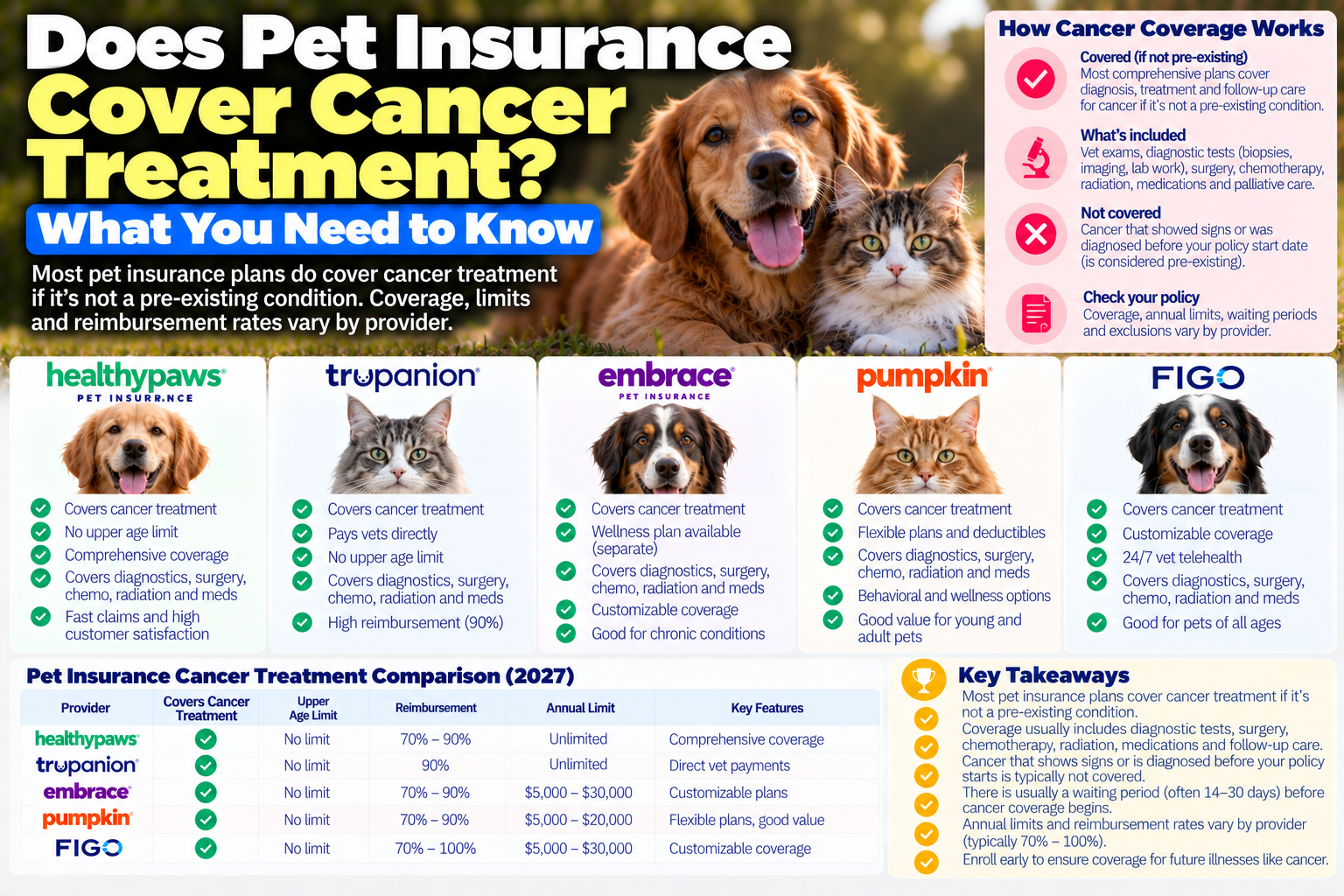
This guide answers a common question: does pet insurance cover cancer? Quick answer: Yes — comprehensive accident-and-illness plans cover cancer treatment, including surgery, chemotherapy. Radiation, as long as the cancer is diagnosed after enrollment and after the waiting period. Roughly one in four dogs will develop cancer in their lifetime. Treatment can run $10,000 or more, which is exactly the kind of cost insurance is built for.
How common cancer is, and what gets covered
Cancer is the leading cause of death in senior pets, and about one in four dogs will develop it at some point. Cats with FIV or FeLV are especially susceptible to lymphoma. This isn’t a rare-event risk — it’s one of the most likely serious diagnoses a pet owner will face.
Comprehensive accident-and-illness plans typically cover the three main treatment paths:
- Surgery to remove a tumor
- Chemotherapy
- Targeted radiation
Diagnostic tests and exams may or may not be included — coverage for these varies by insurer, so check the policy rather than assuming. Some insurers, including Healthy Paws, also cover licensed veterinary acupuncture as a supportive therapy (see our Healthy Paws review).
What cancer treatment actually costs
| Treatment | Cost range |
|---|---|
| Surgery (tumor removal) | $500–$5,000 |
| Chemotherapy, single dose | $150–$600 |
| Chemotherapy, full series | $3,000–$10,000 |
| Conventional radiation (15–20 sessions) | $2,500–$7,000 |
| Bone marrow transplant | From ~$13,000 |
| Palliative care | $1,000–$1,800 |
A full treatment process, combining diagnostics, one or more of the above, and follow-up care over roughly eight weeks, commonly reaches $10,000 or more. And that’s before factoring in a dog whose cancer requires more than one treatment type.
What real claims look like
Two documented Healthy Paws examples show the scale coverage can reach:
- A dog’s policy covered over $18,000 of a $21,000 nasal tumor treatment
- Another dog’s reimbursements totaled $25,040 across diagnosis, chemotherapy, and ongoing care
Healthy Paws advertises coverage up to 90% of diagnosis and treatment costs on its own plans, though the actual percentage any policyholder gets depends on the reimbursement rate chosen at enrollment. These aren’t the typical claim — most cancer cases cost less. But they show why a cap-free or high-limit plan matters for a condition this unpredictable.
Exclusions that still apply
- Pre-existing cancer is never covered. If cancer is diagnosed before you buy a policy, you can still get coverage for everything else. But costs tied to that specific cancer stay excluded for the life of the policy (see pet insurance for pre-existing conditions)
- Accident-only plans don’t cover cancer at all. These plans pay only for accidental injuries. You need an accident-and-illness or comprehensive plan to get any cancer coverage
- Deductibles and copays still apply to cancer claims the same way they do to any other illness claim
- Annual or lifetime limits matter more here than almost anywhere else. A plan capped at $5,000 or $10,000 a year can be exhausted by a single round of chemotherapy and surgery. This is why a high or unlimited annual limit is worth prioritizing specifically because of cancer risk (see pet insurance with no annual limit)
FAQ
Does pet insurance cover chemotherapy? Yes, under a comprehensive accident-and-illness plan, as long as the cancer wasn’t pre-existing. A full chemotherapy series alone can run $3,000–$10,000.
Will pet insurance cover cancer if my dog’s breed is prone to it? Yes — breed predisposition doesn’t make cancer pre-existing. Only an actual diagnosis made before enrollment, or during the waiting period, triggers an exclusion.
How much does cancer treatment cost for a dog without insurance? A full treatment process commonly runs $10,000 or more when diagnostics, surgery, chemotherapy. Follow-up care are combined, though a single treatment type alone can cost less.
What percentage of cancer costs does pet insurance cover? It depends on your reimbursement rate, typically 70–90%. Healthy Paws advertises up to 90% coverage on its own plans, and real claims have reimbursed $18,000+ on a single tumor treatment.
Bottom line
Given that roughly one in four dogs will develop cancer, this is one of the clearest cases for carrying comprehensive illness coverage rather than an accident-only plan. Treatment can realistically reach $10,000 or more, and real claims have paid out well beyond that. Which makes the annual limit you choose matter just as much as whether cancer is covered at all. Enroll before any diagnosis, confirm your plan isn’t accident-only. Lean toward a high or unlimited annual limit if cancer risk is a real concern for your pet’s breed.
Sources
- Cost of Pet Cancer Treatment — Healthy Paws
- Does Pet Insurance Cover Cancer? — Progressive
Key Takeaways on Does Pet Insurance Cover Cancer Treatment
Before you decide on pet insurance cover cancer, get at least three quotes and compare them using the same deductible, reimbursement rate and annual limit. The right answer on pet insurance cover cancer depends on your pet’s age and health, your budget and how much risk you are comfortable carrying yourself. Read the exclusions and waiting periods carefully, because that fine print matters more than the monthly price when you look at pet insurance cover cancer.
Revisit pet insurance cover cancer every year at renewal, since premiums and coverage rules change. If you are still unsure about pet insurance cover cancer, start with the calculator on this site and then request official quotes.
By Joaquín Benicio Conforti · Last updated: October 2026