Quick answer
You don’t need to read six full policy documents to compare pet insurance quotes. Line up each quote’s deductible, reimbursement rate, and annual limit side by side (see how pet insurance deductibles work) (see pet insurance reimbursement rates) (see pet insurance with no annual limit), scan the exclusions list for anything specific to your pet’s breed, and check the waiting periods (see pet insurance waiting periods). That’s the 80% of what actually differs between plans — everything else is mostly marketing.
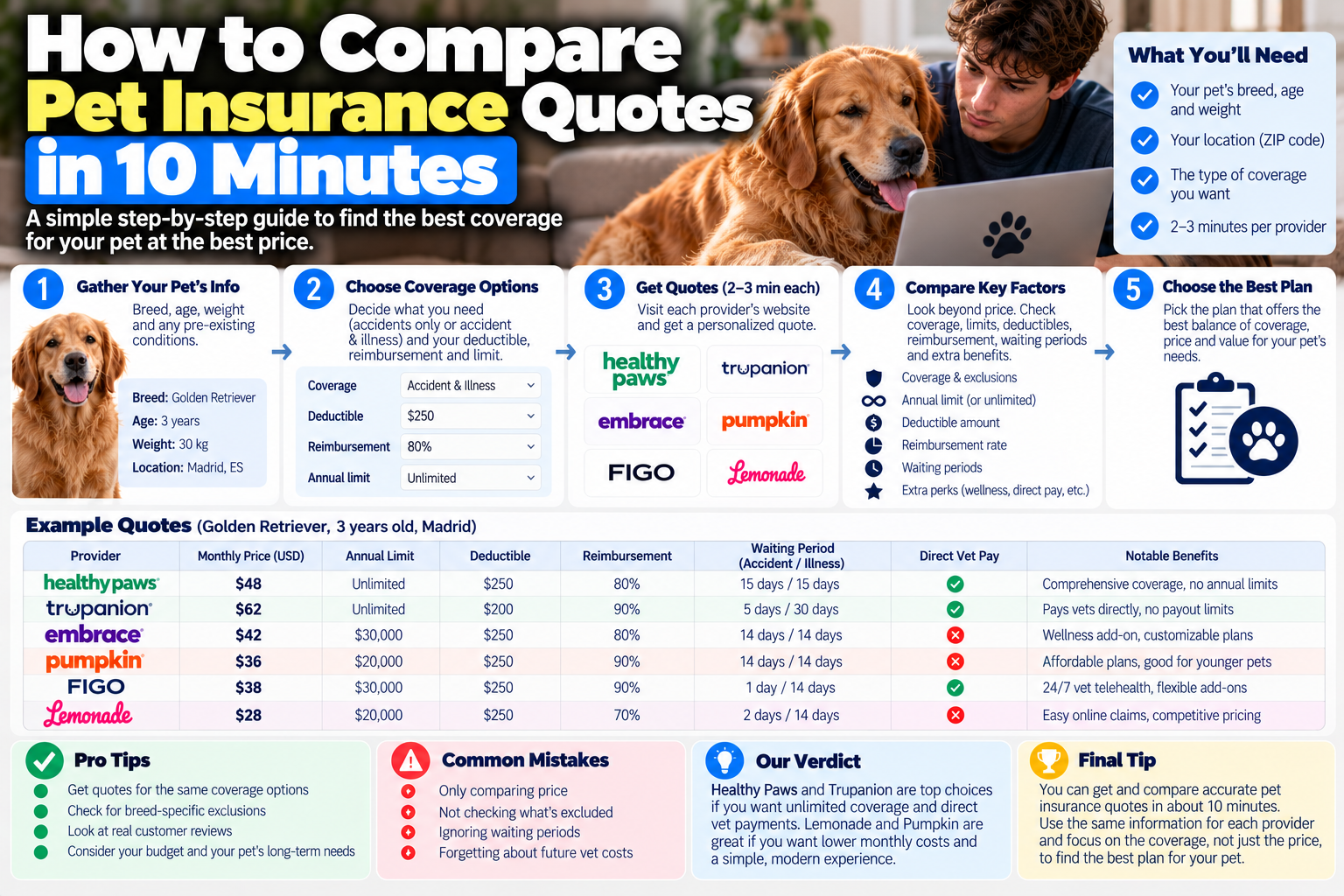
The trap most people fall into is comparing premiums alone. Two quotes at the same monthly price can cover wildly different amounts depending on the deductible/reimbursement/limit combination underneath (see average pet insurance costs).
The 10-minute checklist
- Check what’s actually covered first. Confirm accidents, illness, hereditary/congenital conditions, chronic conditions, surgery, hospitalization, and diagnostics are all included — not just «vet visits.»
- Match coverage to your pet’s breed risks. A large-breed dog prone to hip dysplasia or a Maine Coon with heart-disease risk needs a plan that doesn’t carve out hereditary conditions.
- Line up the deductible, reimbursement rate, and annual limit for every quote in one place — a notes app or spreadsheet works fine.
- Scan the exclusions list for anything that applies to your specific pet: breed-specific exclusions, age limits, or conditions you already know about (see what pet insurance doesn’t cover).
- Check the waiting periods, especially for orthopedic conditions, which run much longer than standard accident/illness waits on some plans.
- Look at claims logistics: average reimbursement time, filing deadline, and whether you can track a claim online.
- Note any extras that matter to you: wellness add-ons, telemedicine, or direct vet pay. These differ a lot between insurers and rarely show up in the headline price.
Doing these seven in order, for each quote, takes about 10 minutes once you know what to look for. Most of that time goes to step 3 and step 4.
The deductible, reimbursement, and limit tradeoff
These three numbers move together, and changing one almost always changes your premium:
| If you choose… | Premium tends to… | What it means for a $3,000 vet bill |
|---|---|---|
| A lower deductible | Go up | You hit your reimbursement % sooner, so you get more back on this bill |
| A higher deductible | Go down | You pay more out of pocket before coverage kicks in on this bill |
| A lower reimbursement rate (e.g. 70%) | Go down | You keep a bigger share of every bill yourself |
| A higher reimbursement rate (e.g. 90%) | Go up | The insurer covers more of every bill |
| A lower annual limit | Go down | Fine for small bills; risky if a big one shows up |
| Unlimited annual/lifetime | Go up | No ceiling, ever, regardless of how large or how often |
There’s no universally «best» combination — it depends on how much monthly premium you can absorb versus how much of a surprise bill you could absorb instead.
Red flags to catch in the fine print
- Per-incident or per-condition sub-limits. A $1,000 cap on dental illness or a 12-week cap on alternative therapy can quietly undercut an otherwise «unlimited» headline number.
- «Curable» pre-existing condition language that’s vague. Some insurers will cover a past condition again after a symptom-free period. But the exact number of days and what counts as «symptom-free» varies a lot — get it in writing.
- An upper enrollment age cap you didn’t notice. A plan that looks great now might refuse to enroll an older pet later, which matters if you’re insuring a pet mid-life.
- Exam fees treated as a separate add-on. If the quote doesn’t mention it, assume exam fees are excluded and check explicitly.
- A short claim-filing deadline. 90 days from treatment is tighter than it sounds if you’re the type to let paperwork sit.
- A reimbursement rate that applies to a «benefit schedule» instead of your actual vet bill. A small number of older-style plans pay a fixed amount per procedure instead of a percentage of what you were actually charged. Always confirm which model you’re being quoted.
A worked example: two quotes that look similar but aren’t
Say you get these two quotes for the same dog:
| Quote A | Quote B | |
|---|---|---|
| Monthly premium | $42 | $41 |
| Deductible | $250 | $500 |
| Reimbursement | 80% | 90% |
| Annual limit | $10,000 | Unlimited |
On a $3,000 covered bill: Quote A pays 80% of ($3,000 − $250) = $2,200, you pay $800. Quote B pays 90% of ($3,000 − $500) = $2,250, you pay $750. Nearly identical on this bill, despite looking different on paper.
Now run a $15,000 bill — a major surgery or a long hospital stay. Quote A’s $10,000 annual limit means you’re capped there regardless of the math; you’d owe roughly $5,000+ out of pocket once the cap is hit. Quote B, with no annual limit, still pays 90% of ($15,000 − $500) = $13,050, leaving you with about $1,950.
At nearly the same monthly price, the two plans are basically interchangeable for small bills and very different for a worst-case one. That’s exactly the kind of gap the checklist above is built to catch.
FAQ
Is the cheapest quote usually the worst deal? Not necessarily, but it’s worth checking why it’s cheaper. Usually a higher deductible, lower reimbursement rate, or a lower annual limit, any of which could matter a lot on a big bill.
Should I use a comparison tool instead of doing this manually? Tools like Pawlicy Advisor can speed up gathering quotes based on your pet’s age, breed, and location. But you still want to run this checklist on whatever 2–3 finalists it surfaces.
How many quotes should I actually compare? Three to five is usually enough to see the real spread in price and coverage without the comparison itself eating hours.
Does a higher premium always mean better coverage? No. Price differences often come down to brand, add-ons, or customer-service reputation rather than the core coverage numbers. Which is exactly why lining up the deductible/reimbursement/limit matters more than the sticker price.
Bottom line
Comparing pet insurance quotes isn’t complicated once you know which three numbers actually drive the outcome: deductible, reimbursement rate, and annual limit. Run the seven-step checklist above on each quote, watch for the fine-print red flags. You’ll have a genuinely informed answer in about 10 minutes — no need to read six full policy documents end to end.
Sources
Sources
Key Takeaways on Compare Pet Insurance Quotes
- Line up each quote’s deductible, reimbursement rate and annual limit side by side.
- You do not need to read six full policy documents to compare plans.
- Check waiting periods and exclusions last, as tie-breakers.
By Joaquín Benicio Conforti · Last updated: October 2026